Is There AI on I AM MUSIC by Playboi Carti Explained
Is there AI on I AM MUSIC? Examine public credits, the reported denial, and track-specific claims, and learn why listening clues alone cannot prove AI use.
 Zhang Guo
Turn a static score into editable MIDI
Contents
Is there AI on I AM MUSIC? The careful answer is that AI use on Playboi Carti's album has not been publicly confirmed. Online claims have focused mainly on the vocals in “RATHER LIE” and “FINE SHIT,” but a suspicious sound, a social post, or an anonymous comment is not production evidence.
The public record is incomplete rather than decisive. Streaming pages show conventional artist and songwriter credits. A secondary news report says Carti denied using AI. Community discussions point to vocal details they find unusual. None of those sources provides a first-party production breakdown, authenticated session history, platform AI disclosure, or provenance record that settles the question.
What the public evidence actually shows
The album's public streaming presentation is ordinary. The Apple Music album page lists MUSIC under Playboi Carti and displays the track list, including “RATHER LIE” with The Weeknd and “FINE SHIT.” Apple also provides a separate guide to viewing song credits, where available performer, composition, production, and engineering roles can appear.
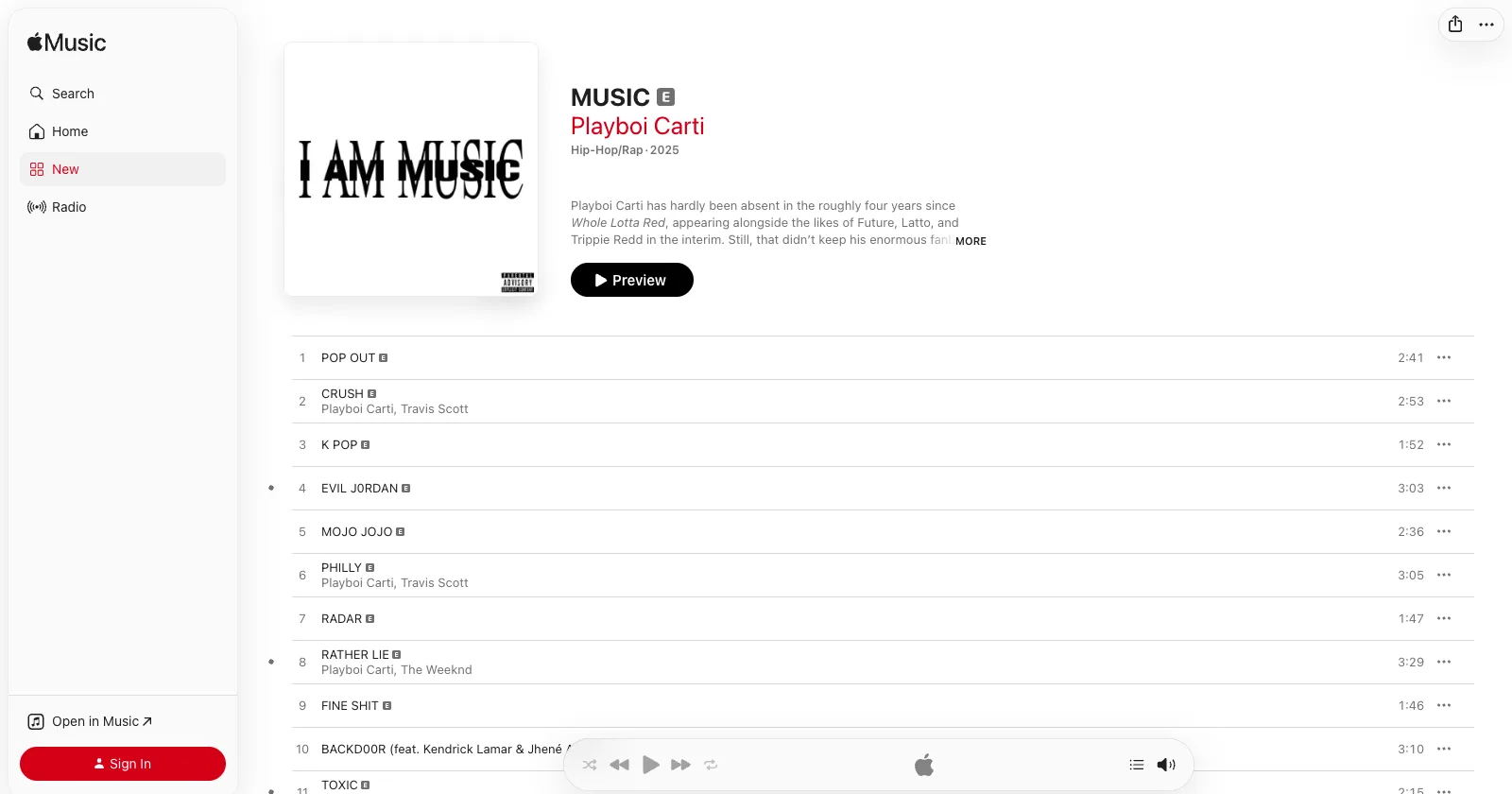
The Qobuz album page likewise exposes conventional release credits for tracks. These records can tell us who was credited as an artist, writer, or performer. They do not disclose every production tool, and they are not a cryptographic record of how a vocal was made.
That distinction matters. A normal credit is evidence about attributed roles. It is not proof that no AI tool touched a demo, edit, effect, or reference vocal. At the same time, the absence of an AI label is not positive evidence that AI was used.
| Public signal | What it supports | What it does not prove |
|---|---|---|
| Apple Music artist and track display | The official catalog presentation and named featured artists | How every vocal or production element was created |
| Qobuz release credits | Publicly attributed contributor roles | A complete, tool-by-tool production history |
| Reported denial | The artist's position as relayed by a secondary outlet | Independent verification of the session process |
| Community listening claims | Which passages listeners want examined | Authorship, model use, or production provenance |
Where the AI claims came from
The claims did not begin with a platform disclosure or a documented studio source. They spread through listener comparisons, social posts, and articles collecting those reactions. An overview from the UCL AI Society discusses the controversy around “RATHER LIE,” “FINE SHIT,” and the earlier “Timeless” debate. That page is useful for mapping the claims, but it is not an official credit source or a forensic report.
The most common argument is based on sound: a phrase seems oddly shaped, a vocal texture resembles an AI cover, or one passage feels inconsistent with another. Those observations can justify a closer listen. They cannot identify a model, show who operated it, or establish whether the released vocal came from generation, resynthesis, pitch processing, comping, compression, or an unusual performance.
“Timeless” also needs to stay separate from the album question. It is a collaboration by The Weeknd featuring Playboi Carti, not a track on MUSIC. Discussion of that song may explain why listeners were already alert to AI rumors, but it cannot prove what happened on “RATHER LIE” or “FINE SHIT.”
What Playboi Carti reportedly denied
HotNewHipHop reported that Carti denied using AI on the album in an exchange surfaced by DJ Akademiks. This is relevant counterevidence because it records a reported artist position. It should still be described as a reported denial, not treated like an independently published studio log.
There is a simple evidence rule here: preserve the distance between a source and a claim. An official production note or direct, archived statement would be stronger than a news account of a social exchange. Original multitracks, session files, or signed provenance would be stronger still.
The reported denial weighs against a confident accusation. It does not create a complete technical account of the recording process, so the conclusion remains limited: no public confirmation of AI use was found, and the available public evidence does not justify a categorical claim.
Why listening alone cannot settle it
Modern vocal production can produce many of the details people associate with generated audio. Heavy pitch correction can reshape transitions between notes. Layered doubles can alter consonants. Time-stretching, denoising, resampling, saturation, and aggressive compression can make a vocal feel unstable or synthetic. A low-quality stream or social-media repost can add more artifacts.
The reverse is also true. A generated or voice-converted part can be edited, re-recorded, layered, and mixed until obvious artifacts disappear. That is why “it sounds like AI” and “it sounds too clean to be AI” are both weak conclusions.
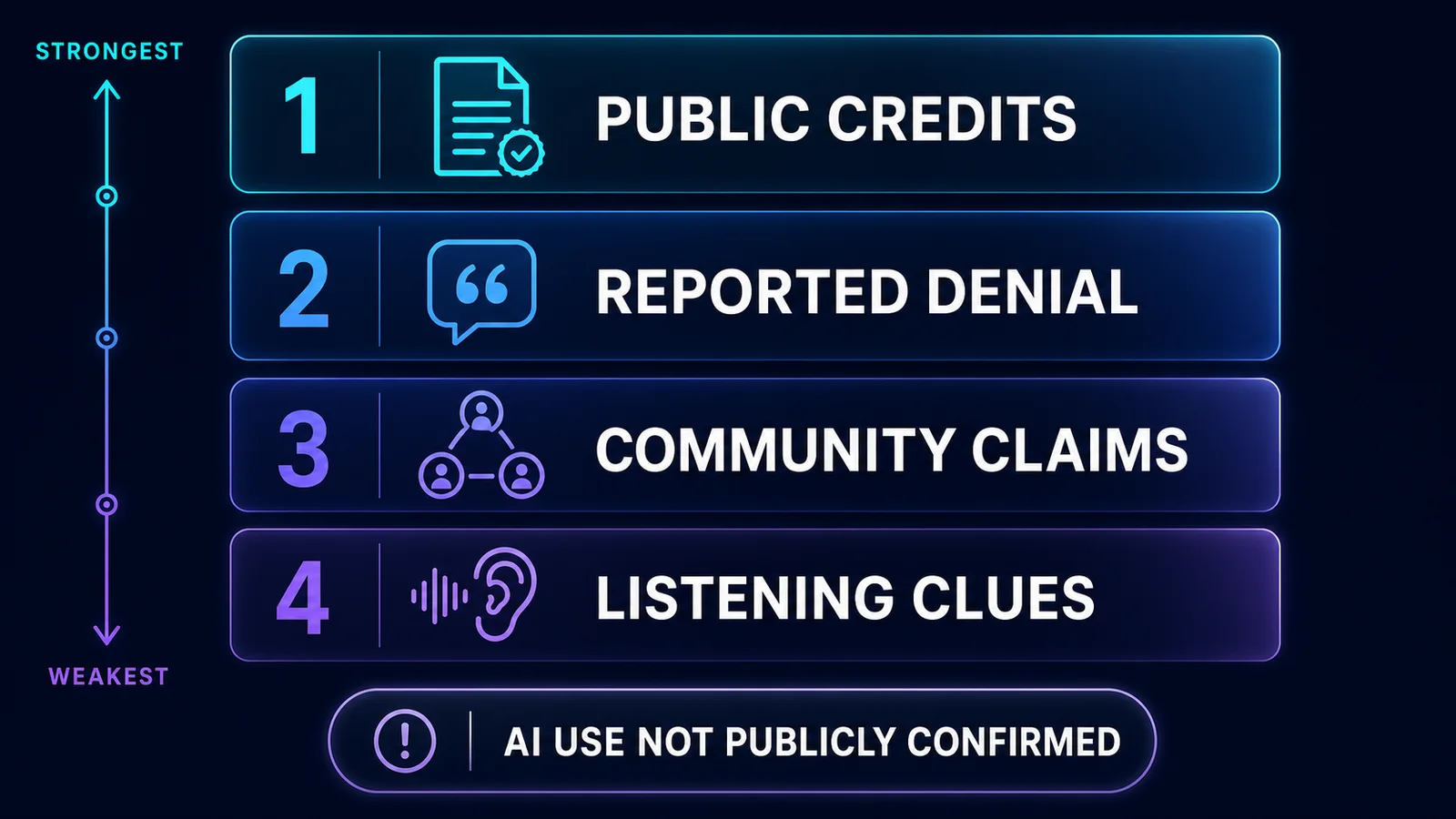
If you want a repeatable method, use the evidence order in how to distinguish AI music:
- Find the earliest first-party release or disclosure.
- Check platform, label, songwriter, performer, and production credits.
- Look for authenticated provenance, session history, stems, or source files.
- Treat detector results as supporting signals with known coverage limits.
- Use careful listening to locate passages for review, not to assign authorship.
This method is less exciting than a viral verdict, but it is easier to defend and less likely to turn an audio artifact into a false accusation.
What evidence would change the answer
The answer should change if stronger evidence appears. Useful evidence could include a first-party production breakdown naming an AI contribution, a platform or distributor credit that identifies a generated role, authenticated project records, or a verifiable provenance credential attached to the released asset.
The details would matter. “AI was used” can mean generated lyrics, a reference vocal, voice conversion, an instrumental stem, editing assistance, mastering, or a fully generated performance. Those are different claims with different creative and rights implications. A future disclosure should be reported at the role level instead of being flattened into one label for the whole album.
Until then, the fair confidence scale is:
- Publicly confirmed: not established by the sources reviewed here.
- Strongly supported: not established without independent production evidence.
- Possible: a reasonable description of the unresolved claims around specific vocals.
- Unverified: the best overall label for the current public record.
For background on these categories, what AI music is explains why AI-assisted production and a fully generated song are not interchangeable.
Analyze the music without claiming its origin
You can still study the album's musical structure without turning the analysis into an authorship detector. Melogen Song Analyzer can help document sections, harmony, mood, instrumentation, and production changes in an audio file you are allowed to upload.
It cannot prove whether a human or AI system created a vocal. Use it to compare passages and organize musical observations, then keep provenance, credits, disclosures, and AI-origin claims in a separate evidence record.
Inspect the track without guessing its authorship
Use Melogen Song Analyzer to document structure, harmony, mood, and production details. Keep AI-origin conclusions tied to credits and provenance evidence.
FAQs
Is “RATHER LIE” confirmed to use AI vocals?
No public first-party disclosure, platform AI credit, or authenticated production record reviewed for this article confirms that claim. Listener reactions can identify a disputed passage, but they do not establish how the vocal was made.
Is “FINE SHIT” confirmed to be AI-generated?
No. The track appears in public release listings with conventional credits, while online discussions raise questions about its sound. Conventional credits do not disclose every production tool, but community claims do not prove generation either.
Did Playboi Carti deny using AI on I AM MUSIC?
A secondary music-news report says he denied it in a social exchange surfaced by DJ Akademiks. Because the available source is a report of that exchange, the precise label is “reported denial.”
Can an AI music detector settle the question?
Not by itself. Detector coverage varies by model, audio quality, editing, and whether the track mixes generated and human elements. A detector score would need corroboration from source records, disclosures, or provenance before supporting a public accusation.
The evidence-led conclusion
There is no solid public basis for saying that I AM MUSIC is confirmed AI music. There are track-specific allegations, a reported denial, standard public credits, and unresolved listening observations. There is not a verified production record that joins those pieces into a definitive answer.
The responsible conclusion is therefore narrow: AI use is not publicly confirmed. If stronger first-party or authenticated evidence emerges, the answer can be updated. Until then, treat “RATHER LIE” and “FINE SHIT” as disputed tracks, not proven AI productions.
About the author
Zhang Guo
Composer - AI Product Manager
AI product manager and digital marketing consultant with a background in music. Creativity is the bridge between rhythm and logic, where musical intuition and mathematical precision can coexist in every meaningful product decision.
Follow on X