How to Distinguish AI Music With Real Evidence in 2026
Learn how to distinguish AI music using credits, provenance, detector tools, and careful listening without treating any single clue as definitive proof.
 Zhang Guo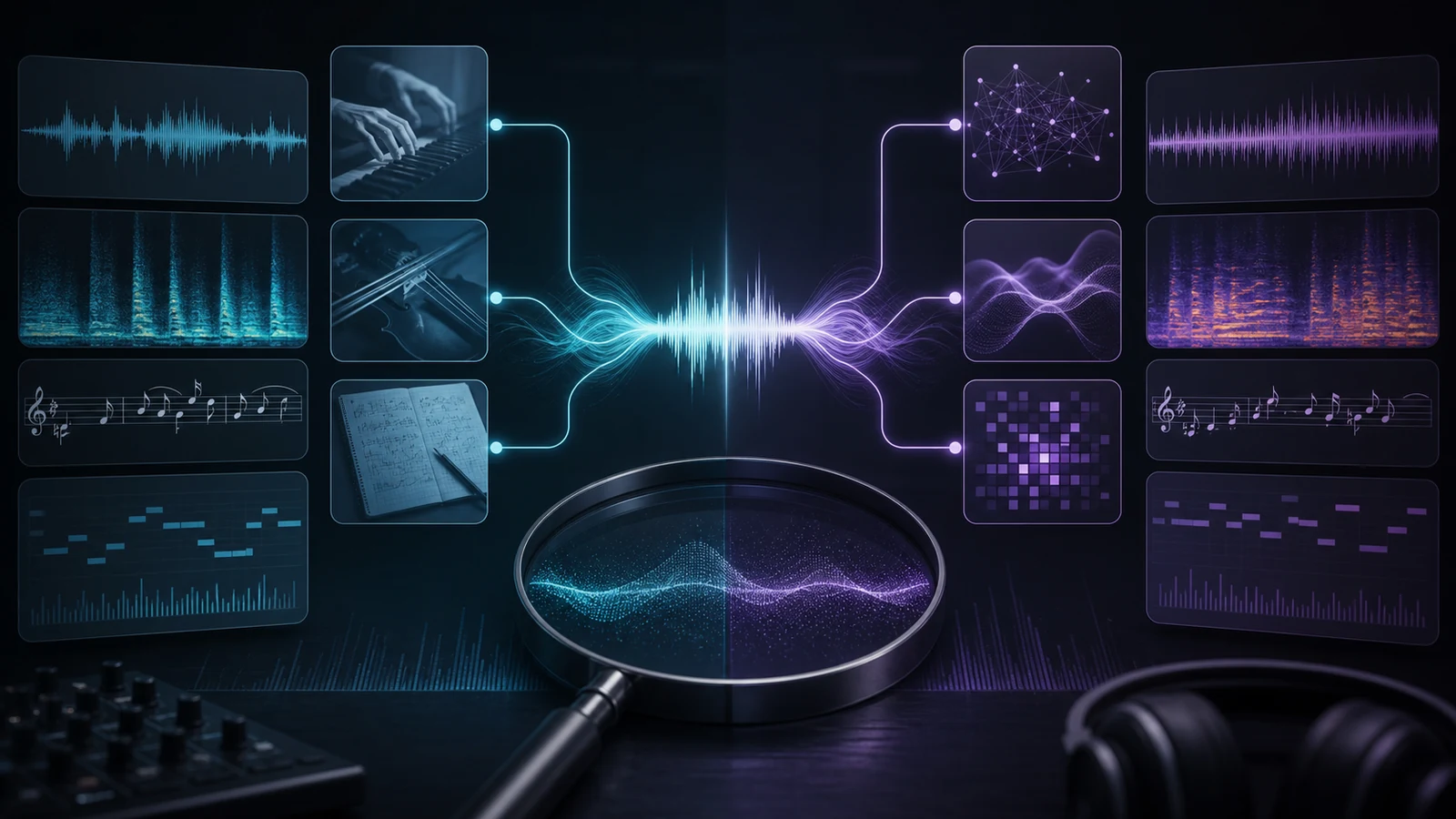
Turn a static score into editable MIDI
Contents
If you are learning how to distinguish AI music, do not start with a single strange lyric, an unusually clean vocal, or a detector score. Start with evidence: where the track came from, what the creator or distributor disclosed, whether the file carries trustworthy provenance, and whether several independent signals agree.
Careful listening still helps, but it is the weakest part of the chain when used alone. Human producers can make rigid, glossy, repetitive music. AI-assisted tracks can also contain human vocals, live instruments, editing, and mixing. The useful goal is not to win a guessing game. It is to reach a confidence level you can explain.
How to distinguish AI music in practice
Use this order when the answer matters:
- Check the original source, artist page, release notes, and distributor credits.
- Look for platform-level AI disclosures or role-based credits.
- Inspect provenance, source files, stems, session history, or Content Credentials when available.
- Run a reputable detector as one additional signal, not as the verdict.
- Listen for repeated artifacts and production inconsistencies.
- Report the result as disclosed, supported, likely, or uncertain instead of forcing a binary label.
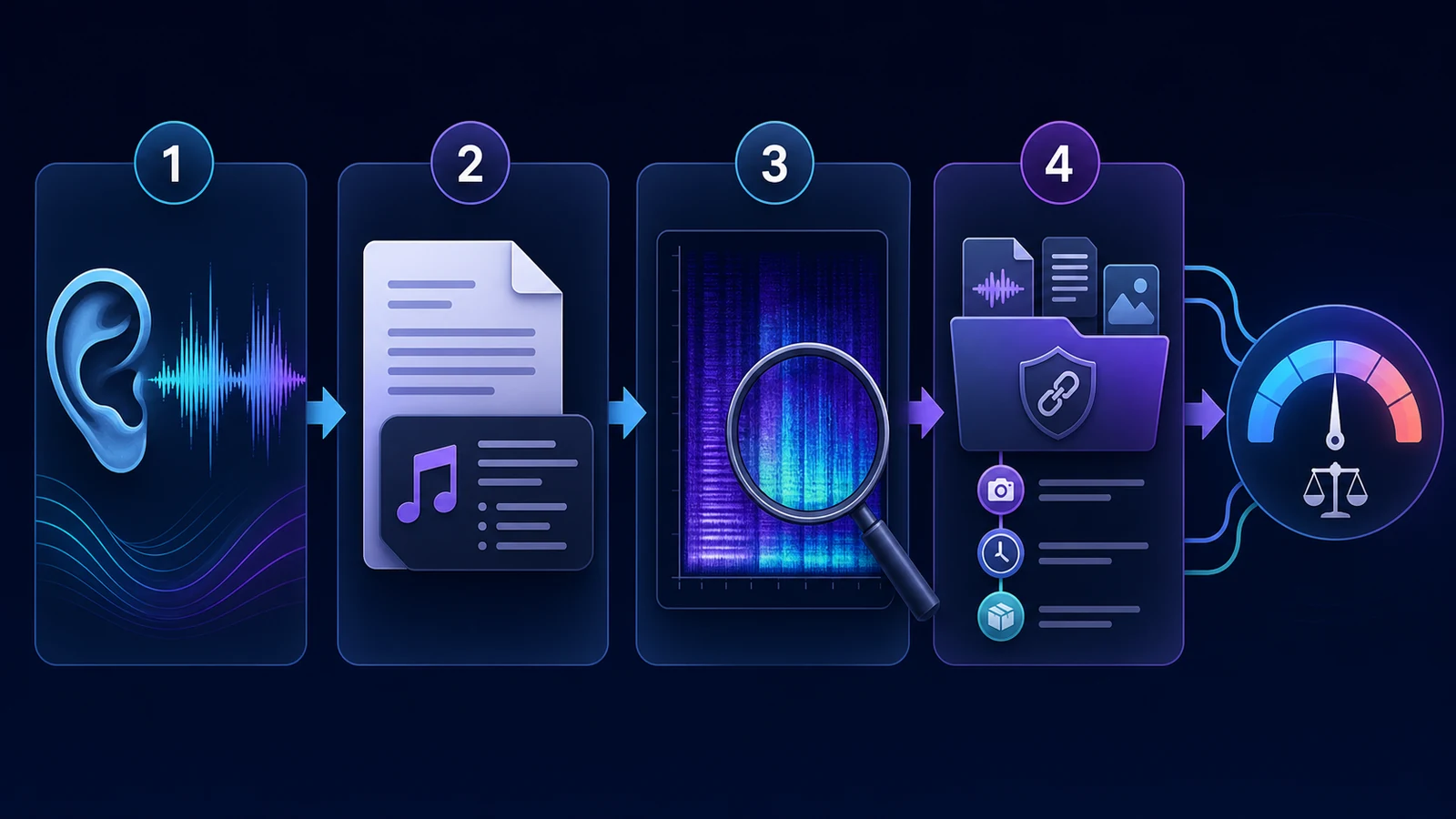
This sequence protects you from the most common mistake: hearing one odd detail and turning it into an accusation. It also works when AI is only one part of the production. A track may use generated lyrics but human vocals, generated instruments under a live performance, or AI-assisted mastering on otherwise human-made music.
If you first need the broader category explained, read what AI music is and how it works. The question here is narrower: what evidence can support a judgment about one specific track?
Step 1 check the source before the sound
The source can tell you more than the waveform. Start at the earliest public or private record you can verify.
For a released track, check:
- the artist's official page and release notes
- the distributor or label credits
- songwriter, performer, producer, and instrumentalist fields
- descriptions attached to the original upload
- whether the creator explains which parts used AI
For a file shared inside a team, ask for the project history instead of a promise. Stems, a DAW session, MIDI files, lyric drafts, dated exports, and revision notes can show how the work developed. None of these artifacts proves that every sound was made without AI, but together they provide a much stronger production trail than an isolated MP3.
The catch: missing information is not proof of AI use. Small artists often have incomplete credits. Files lose metadata during export. Social platforms strip context. Record the absence as unknown rather than converting it into a conclusion.
Step 2 read AI credits and labels carefully
Platform labels are changing quickly, and they do not all mean the same thing. Spotify's current AI credits guidance says its beta credits can identify AI use in specific roles such as lyrics, vocals, instrumental performance, or production. The credits are optional, depend on distributor support, and do not appear as a track-level AI label.
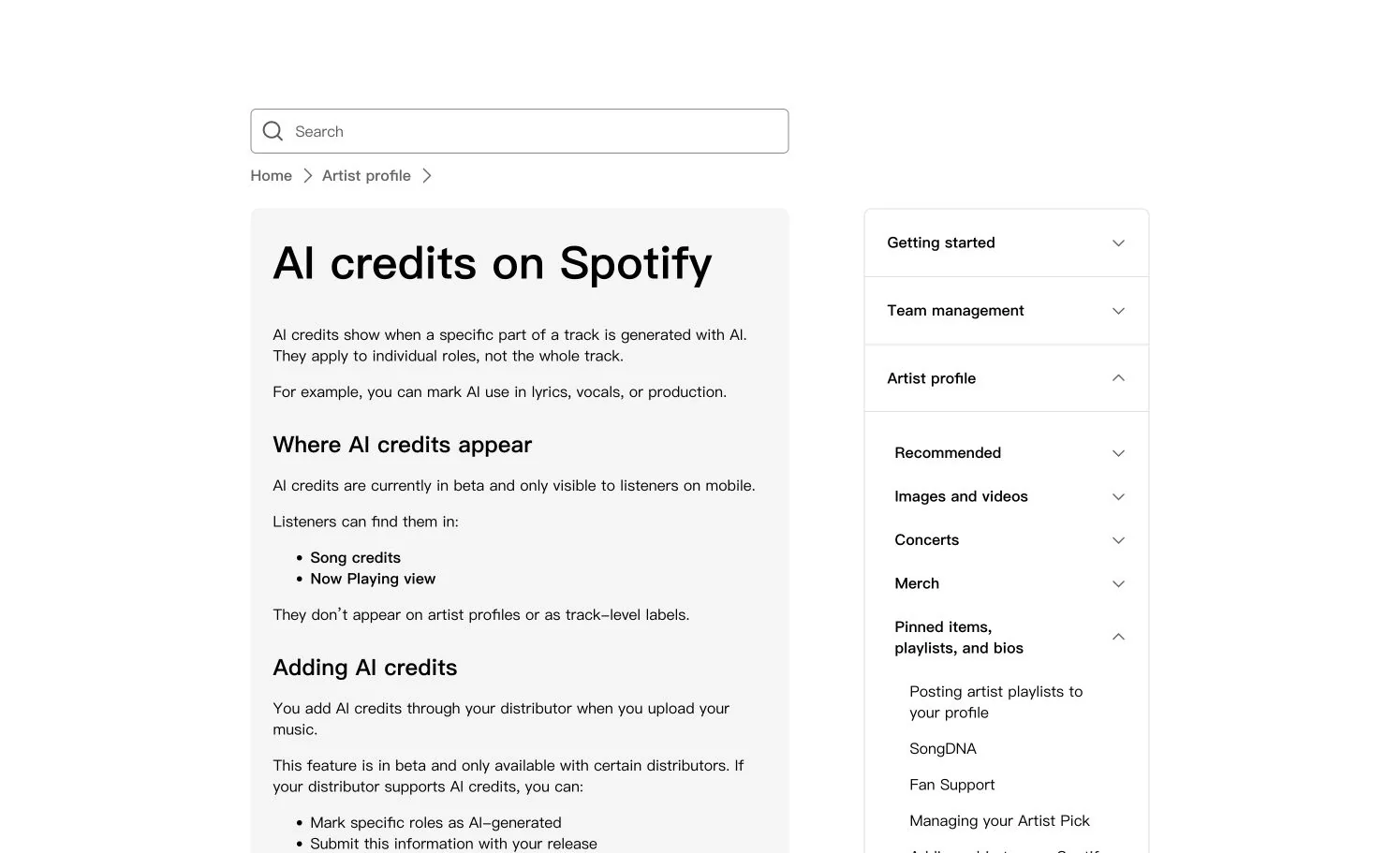
That creates two important rules:
- A visible AI credit is useful positive evidence about the named contribution.
- No visible AI credit does not prove that the track was made without AI.
Also avoid collapsing a role-level credit into a whole-song verdict. AI-assisted production is different from a fully generated track. A disclosed AI lyric contribution does not tell you who sang, played, arranged, edited, or mixed the release.
The same caution applies to creator statements. A clear first-party disclosure is valuable, but the wording matters. Look for what was generated, what was edited, and who made the final decisions.
Step 3 use AI music detectors as supporting evidence
An AI music detector can compare audio against patterns associated with known generation systems. This is useful at scale, especially when a platform has access to large model-specific training sets and repeated delivery data. It is still not a universal authorship test.
Deezer announced a free AI music detector for playlists in June 2026 and says its system detects and labels fully AI-generated music on Deezer. Its public description focuses on models such as Suno and Udio and on scanning playlists across major streaming services.
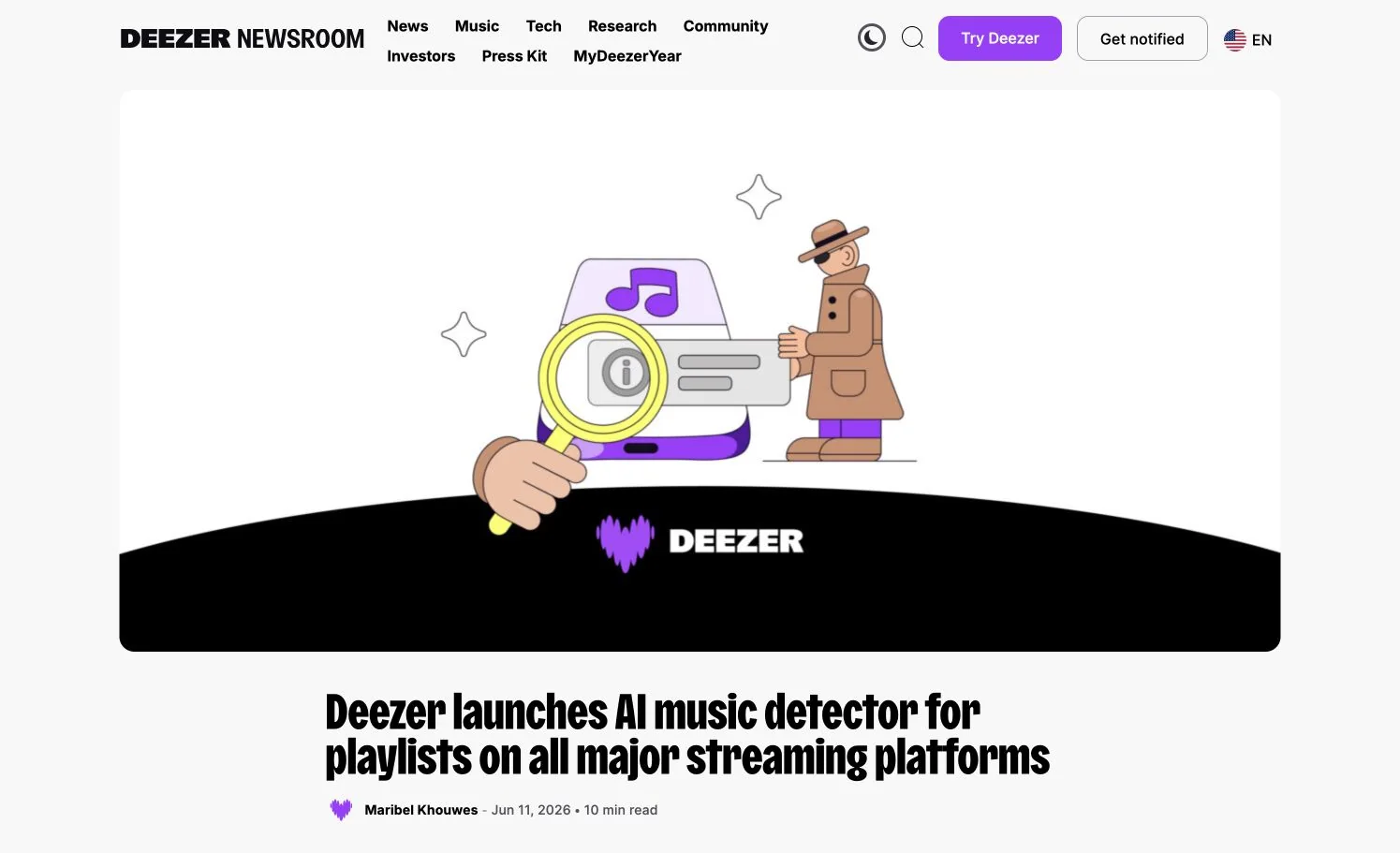
Use detector output with these limits in mind:
| Detector result | What it can support | What it cannot prove by itself |
|---|---|---|
| High AI likelihood | The audio resembles patterns the detector associates with supported generators | Which model made it, who prompted it, or whether humans edited it |
| Low AI likelihood | The detector did not find strong known signals | That no AI tool touched the lyrics, arrangement, mix, or master |
| Mixed or partial signal | Some sections may differ from the rest | Which contribution is synthetic without section-level evidence |
| No result | The file, model, or audio quality may be outside the detector's coverage | Anything about authorship |
For a low-stakes curiosity, one detector may be enough to guide the next check. For moderation, licensing, payment, takedown, or public allegations, require corroborating evidence and a human review.
Step 4 listen for patterns without treating them as proof
Listening is best used to decide where to investigate next. Compare multiple sections and listen on headphones before calling any artifact meaningful.
Common clues include:
- syllables that smear, change identity, or land unnaturally against the beat
- repeated breaths, consonants, ornaments, or transition shapes
- instruments whose attack, room sound, or playing technique changes without a musical reason
- dense arrangements that lose separation during busy passages
- abrupt shifts in stereo width, ambience, or vocal character
- lyrics that preserve rhyme and mood but lose narrative continuity
- forms that repeat surface detail while failing to develop the musical idea
Every item on that list has a human-production explanation. Heavy pitch correction can reshape consonants. Sample libraries can repeat attacks. Low-bitrate encoding can smear cymbals and vocals. A rushed mix can create unstable ambience. A human songwriter can repeat empty phrases.
The right question is not, "Does this sound weird?" Ask, "Do several unrelated clues appear in the same track, and do the source records support the same conclusion?"
Use provenance when the decision has consequences
Provenance records move the investigation from sound to history. The C2PA Content Credentials explainer describes a tamper-evident record that can include a media asset's origin, edits, and use of AI. Audio is within the standard's media scope.
Content Credentials are not a magic truth badge. They verify that signed provenance information is attached to the asset and has not been silently altered. They do not guarantee that every statement is complete, and their absence does not prove deception because adoption is optional.
For a practical evidence file, save:
- the original URL and access date
- screenshots of platform credits or creator disclosures
- the original audio file and checksum when permitted
- detector name, version or date, and full output
- timestamps for the passages that triggered manual review
- the final confidence label and the evidence behind it
This record matters more than a confident sentence. Another reviewer should be able to understand how you reached the result and where uncertainty remains.
Choose a confidence label you can defend
Use a small confidence scale instead of yes or no:
| Label | Minimum evidence |
|---|---|
| Disclosed AI use | First-party, distributor, platform, or verifiable provenance record names the AI contribution |
| Strongly supported | Multiple independent signals agree and source context does not contradict them |
| Possible AI use | Some clues or one detector suggest AI, but corroboration is missing |
| Uncertain | Evidence is mixed, unavailable, or too weak to classify |
| Supported human production | Credible project history, performers, source files, and provenance support a human-led workflow |
When publishing a result about someone else's work, prefer "unverified" or "possible" over a categorical accusation unless the evidence is clear. The reputational risk belongs to a real person even when the detector output looks precise.
Where Melogen fits and where it does not
Melogen's Song Analyzer can inspect musical structure, harmony, production choices, section flow, and reference characteristics. That can help you compare passages and document what changes across a track.
It is not an AI-authorship detector. A structure report cannot prove whether a human or a generator made the music. Use it for musical analysis after you have separated the provenance question from the composition and production question.
Analyze the track without guessing its authorship
Use Melogen Song Analyzer to inspect structure, harmony, and production details, then keep provenance and AI-origin claims in a separate evidence review.
If your next step is publishing your own generated or AI-assisted work, the guide to uploading AI music to SoundCloud covers rights, disclosure, metadata, and platform-readiness checks.
FAQs
Can you tell if a song is AI-generated just by listening?
Not reliably. Listening can reveal artifacts worth checking, but polished AI music may sound convincing and human productions can contain the same anomalies. Use source records, credits, provenance, and detector evidence together.
Are AI music detectors accurate?
Some detectors report strong performance for specific supported models and datasets. That does not make every detector universal. Results can change with new models, human editing, compression, short clips, stems, and mixed AI-human production.
Does Spotify label every AI-generated song?
No. Spotify currently uses optional, role-based AI credits in beta for participating distributors. The credits can identify AI involvement in lyrics, vocals, instruments, or production, but they are not a universal track-level label.
Does missing metadata mean the music is AI-generated?
No. Metadata can be incomplete, stripped, or poorly maintained. Missing information should increase uncertainty, not automatically increase confidence that a track is AI-generated.
Can Content Credentials prove a track is authentic?
They can provide tamper-evident information about origin and editing history when a supported file carries a valid credential. They do not guarantee that every fact is present or make a moral judgment about the production.
The practical takeaway
The best way to distinguish AI music is to build an evidence chain. Check the source, read role-level disclosures, inspect provenance, use detector results carefully, and listen for repeated artifacts only as supporting clues.
One clue is a question. Several independent signals are a case. A verifiable disclosure or production history is stronger still. When the evidence stops, your confidence should stop with it.
About the author
Zhang Guo
Composer - AI Product Manager
AI product manager and digital marketing consultant with a background in music. Creativity is the bridge between rhythm and logic, where musical intuition and mathematical precision can coexist in every meaningful product decision.
Follow on X