Most Used Chords on Guitar for Beginner Practice Songs
Learn the most used chords on guitar with beginner shapes, switch drills, song-ready progressions, and a Melogen tab workflow for practice.
 Zhang Guo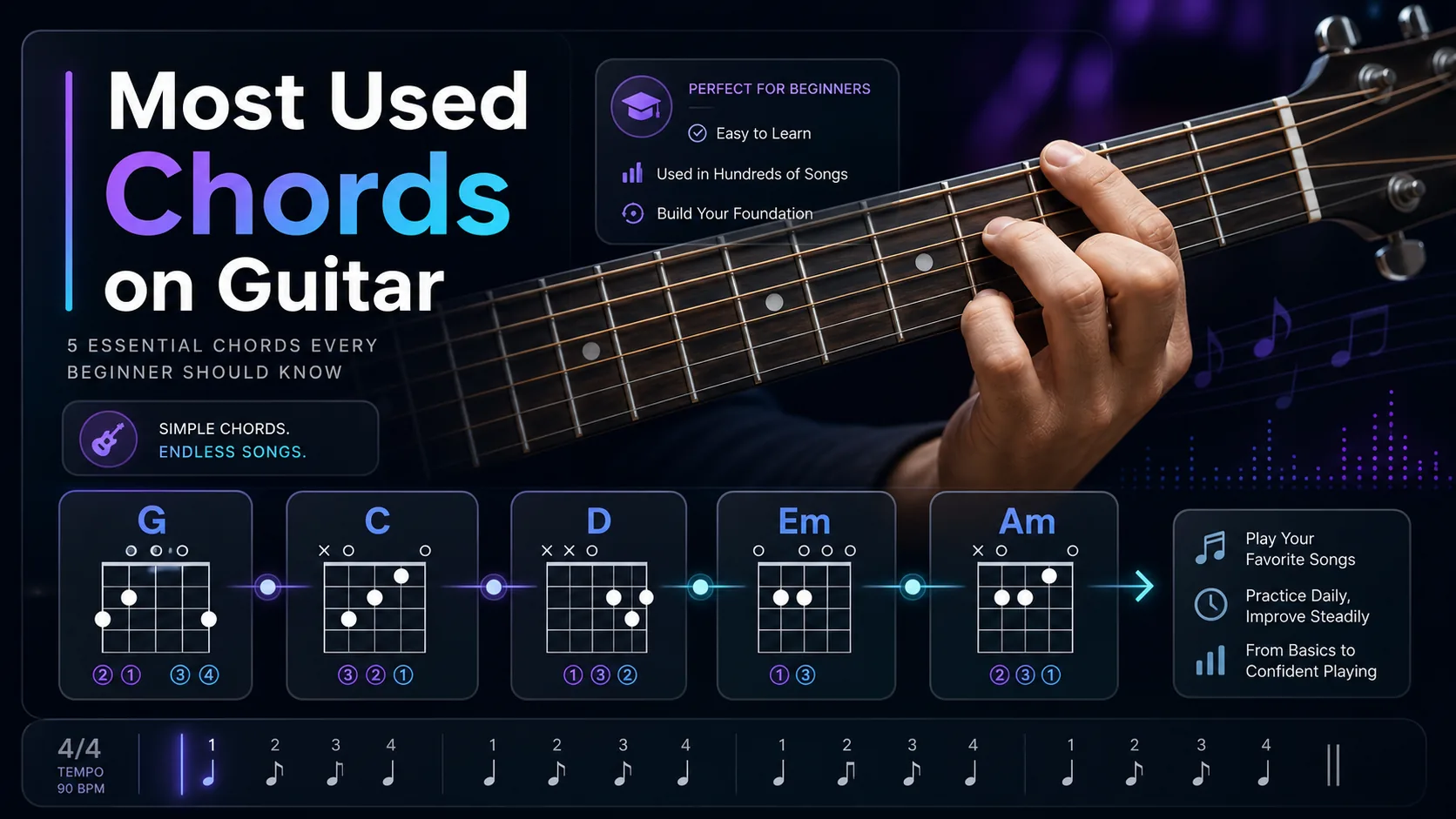
Turn a static score into editable MIDI
Contents
The most used chords on guitar are the open shapes that let beginners play real progressions before barre chords, theory names, or fast strumming get in the way. Start with G, C, D, Em, and Am. Add E, A, and F when your hand can switch cleanly.
That small chord set is useful because it teaches the habits that repeat everywhere: relaxed fingers, clean string contact, steady rhythm, and simple movement between major and minor colors. This guide gives you the chord map, the practice order, the progressions to try first, and a Melogen workflow for turning songs or audio references into readable guitar practice material.
Start with the chords beginners actually reuse
The first useful chord list is not the longest one. It is the smallest set that appears in beginner songs, strumming patterns, and simple progressions. These chords keep you in open position, use familiar string groups, and give your ear clear major/minor contrast.
| Chord | Family | Why it matters | First practice pair | Watch for |
|---|---|---|---|---|
| G | Major | Bright home chord in folk, pop, country, and worship songs | G to D | Keep the ring and pinky fingers relaxed |
| C | Major | Common arrival chord and strong contrast against G | C to G | Do not mute the first string by accident |
| D | Major | Strong lift chord that often returns to G | D to G | Keep the third finger curved |
| Em | Minor | Easiest minor shape and a quick emotional color change | Em to G | Let all six strings ring cleanly |
| Am | Minor | Common minor shape that connects well to C and E | Am to C | Keep the index finger close to the first fret |
| E | Major | Foundation for blues, rock, and later barre-chord logic | E to Am | Do not squeeze harder than needed |
| A | Major | Compact shape used in many I-IV-V progressions | A to D | Fit three fingers without collapsing the knuckles |
| F | Major or simplified F | First harder shape, useful once open chords feel stable | F to C | Start with a small F before forcing a full barre |
If guitar string names still feel unstable, pause and review electric guitar string notes. The chord shapes make more sense when you can name the open strings under your fingers.
Use the five chord map before adding more shapes
The fastest first win is a five-chord map: G, C, D, Em, and Am. You can think of them as a practice path rather than a dictionary. G, C, and D give you the main major sound. Em and Am give you two minor colors without changing hand position too much.
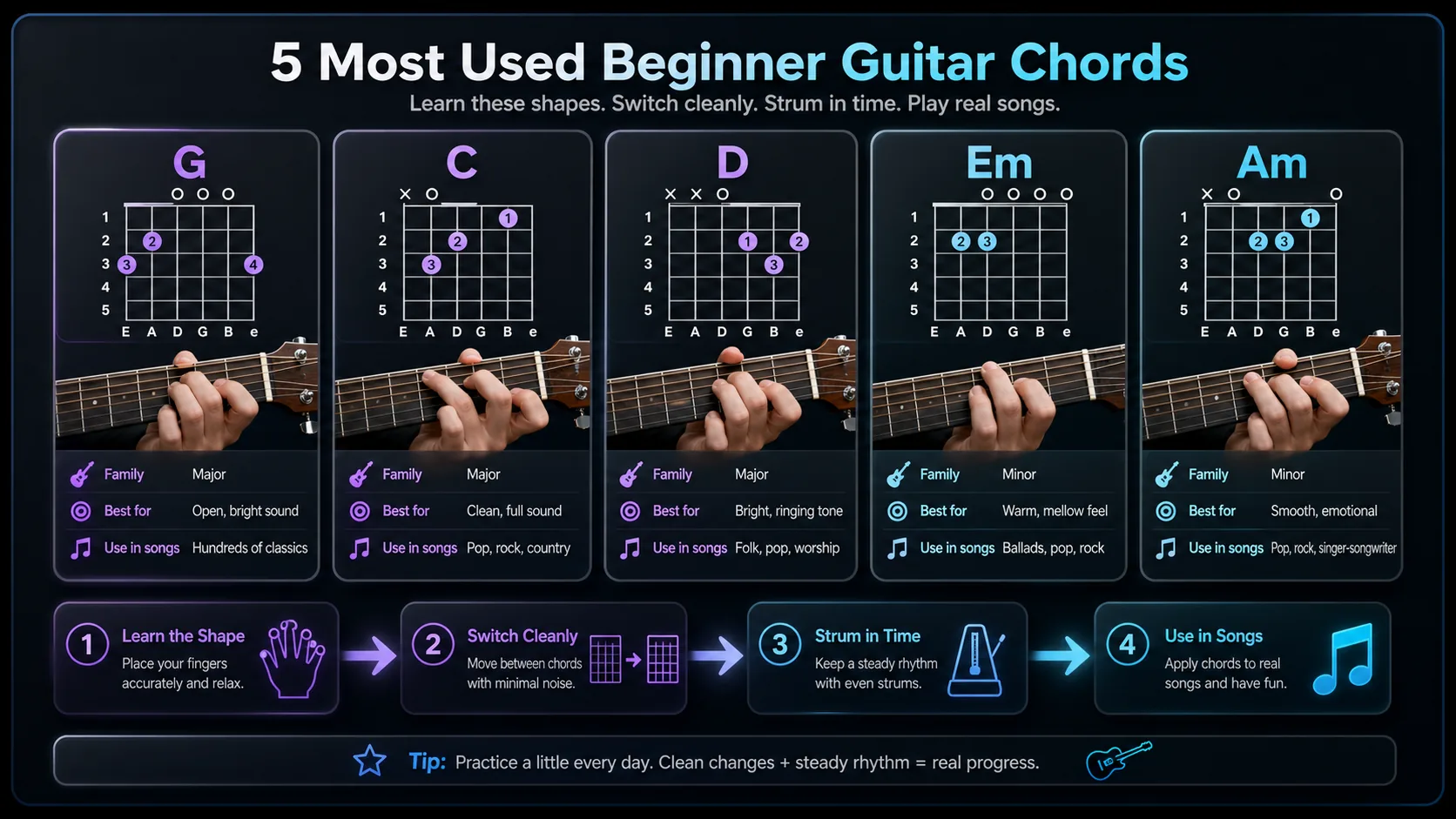
Use this order:
- Learn the shape slowly.
- Place every finger without strumming.
- Strum once and listen for muted strings.
- Lift the hand, reset, and place it again.
- Switch to the next chord only after the first one sounds clean.
Do not start with speed. Start with repeatability. The test is whether the chord sounds the same three times in a row. If it does not, slow down and find the finger that is muting, buzzing, or arriving late.
Practice clean switches before adding songs
Most beginner frustration comes from the space between chords, not from the chord shapes themselves. A song falls apart when the left hand is still searching after the beat arrives. Train the switch as its own skill.
Use a two-minute loop:
| Drill | Timer | Goal | Pass condition |
|---|---|---|---|
| Silent placement | 30 seconds | Place G, lift, place G again | Fingers land together without panic |
| Two-chord switch | 45 seconds | Move G to D, then D to G | Both chords ring without long pauses |
| Slow strum loop | 45 seconds | One downstroke per beat | The switch happens before beat one |
| Cleanup pass | 30 seconds | Fix one muted or buzzing string | The correction is specific, not random |
Start with these pairs:
- G to D
- G to C
- C to Am
- Em to G
- Am to E
- D to A
Once one pair is clean, put it into rhythm. Count 1 2 3 4, strum on beat one, and move during beat four. That habit matters more than fancy strumming because it teaches your hand to prepare before the chord change lands.
If rhythm notation is the harder part, the guide on how to read strumming patterns is the natural next step.
Turn common chords into song-ready progressions
After the shapes feel stable, combine them into progressions. A progression is simply a chord order that creates motion. You do not need advanced theory yet. You need a few loops your ear can recognize and your hand can repeat.
Try these first:
| Progression | Chords in G or C | Best for | Practice note |
|---|---|---|---|
| I-IV-V | G-C-D | Folk, country, early rock, worship | Count slowly and keep the D shape clear |
| I-V-vi-IV | G-D-Em-C | Pop choruses and familiar singalong loops | Keep Em relaxed so the change into C is not rushed |
| vi-IV-I-V | Em-C-G-D | Softer verse loops and minor-color openings | Listen for the lift from Em into C |
| I-vi-IV-V | C-Am-F-G | Older pop, ballads, doo-wop style harmony | Use a simplified F if the full barre is not ready |
| i-VI-III-VII | Em-C-G-D | Minor pop and cinematic loops | Let Em feel like home before moving away |
This is where the existing Melogen guide to guitar chord progressions becomes useful. This article focuses on the chord shapes themselves; that one helps you decide what a progression should do inside a verse, chorus, bridge, or practice sketch.
Use easier versions of hard chords
The F chord is the classic beginner wall. Do not turn it into a referendum on whether you can play guitar. Use a smaller version while your hand builds strength.
Good F options:
| Version | Fingering idea | When to use it |
|---|---|---|
| Mini F | Top four strings only | Early songs that need F but not a full bass note |
| Fmaj7 | Leave the high E open | Softer pop or acoustic practice |
| Full barre F | Barre across the first fret | Later, when thumb position and finger pressure are stable |
The same logic applies to Bm, B, and harder barre shapes. Use the version that keeps the rhythm alive. A simplified chord played in time teaches more than a full shape that stops the song every bar.
Where Melogen fits after your hands know the shapes
Melogen should not replace chord practice. It helps after you have enough chord vocabulary to make sense of a song, riff, or audio reference. The current AI Guitar Tab Generator page supports audio files and YouTube links, with guitar-specific controls such as tuning, capo position, focus mode, and complexity level.

Use it like this:
- Pick a short section of a song you want to practice.
- Generate a first guitar tab or chord-oriented reference.
- Compare the output against the common chord shapes you already know.
- Slow down the hard change and practice it as a two-chord switch.
- Return to the song only after the switch feels stable.
That workflow keeps the tool in the right role. Melogen gives you a draft reference. Your ear and hands still make the musical decisions.
Turn a song into a guitar practice reference
Use Melogen AI Guitar Tab Generator when your source is audio or a YouTube link and you need a playable first pass before cleaning chord changes by hand.
Common mistakes with beginner guitar chords
Small technical mistakes can make easy chords sound harder than they are.
| Mistake | What it sounds like | Fix |
|---|---|---|
| Flat fingers | Muted strings | Curve the fingertip and move closer to the fret |
| Thumb too high or too tense | Hand locks up during switches | Let the thumb support without squeezing |
| Strumming all strings on every chord | Muddy sound | Check which strings belong to the chord |
| Practicing only one chord at a time | Good shapes but slow songs | Practice pairs and progressions |
| Speeding up too soon | Buzzing and missed beats | Use a metronome or count out loud |
The point is not perfection. The point is diagnosis. Name the exact problem, fix that one thing, then repeat the chord in rhythm.
FAQs
What are the most used chords on guitar?
For beginners, the most useful set is G, C, D, Em, Am, E, A, and a simplified F. They cover many open-position songs and prepare your hand for later barre chords.
Should I learn chords or tabs first?
Learn a few open chords first if your goal is singing, strumming, or playing beginner songs. Learn tab early if your goal is riffs, melodies, or specific guitar parts. Most guitarists eventually need both, and how to read guitar tabs is the practical companion once the chord shapes are familiar.
Why do my easy guitar chords buzz?
Buzz usually means the finger is too far from the fret, the fingertip is too flat, or the hand is squeezing unevenly. Move closer to the fret wire, curve the fingertip, and strum one string at a time to find the problem.
How many chords should a beginner know first?
Five is enough for the first stage: G, C, D, Em, and Am. Add E, A, and F after those switches feel clean in time.
The practical takeaway
The most used chords on guitar are useful because they turn practice into music quickly. Start with G, C, D, Em, and Am. Practice the switches before chasing more shapes. Add E, A, and simplified F when your timing stays steady.
Once the shapes feel real under your fingers, use songs, tabs, or Melogen-generated references to give the chords context. The goal is not to collect chord names. It is to make common chords sound clean, timed, and musical.
About the author
Zhang Guo
Composer - AI Product Manager
AI product manager and digital marketing consultant with a background in music. Creativity is the bridge between rhythm and logic, where musical intuition and mathematical precision can coexist in every meaningful product decision.
Follow on X