Traditional Jazz Bands History, Instruments, and Repertoire
Learn how traditional jazz bands work, from New Orleans front-line roles and rhythm sections to repertoire, charts, rehearsal, and ensemble size.
 Zhang Guo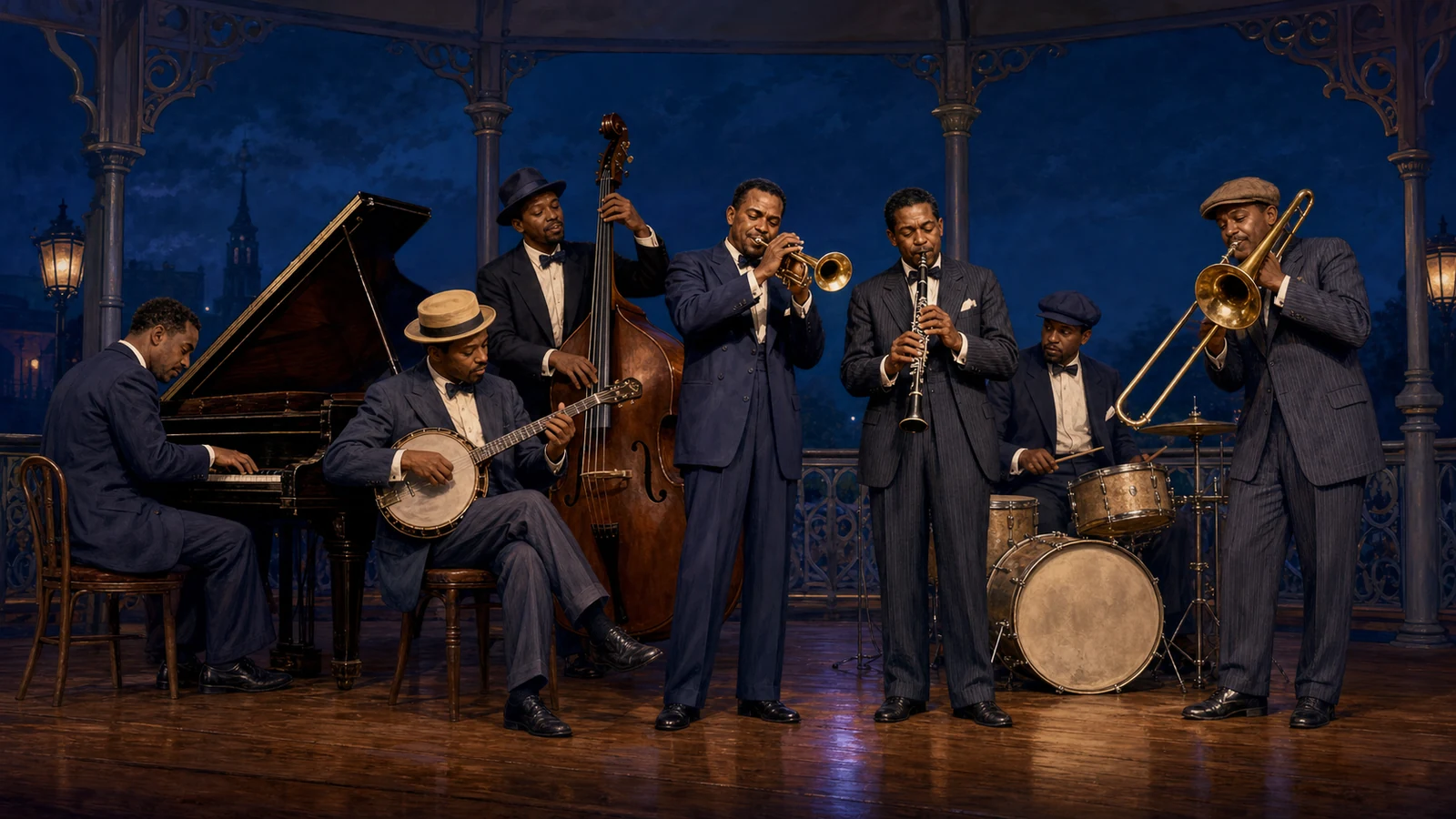
Turn a static score into editable MIDI
Contents
Traditional jazz bands usually place a three-horn front line—cornet or trumpet, clarinet, and trombone—in conversation with a rhythm section such as banjo or guitar, piano, bass or tuba, and drums. The lineup is recognizable, but it is not a fixed formula. A working band might be a compact quartet, a seven-piece dance band, or something in between.
The style is defined less by headcount than by how the players share the music. The melody stays audible, the front line answers and overlaps, and the rhythm section creates a pulse that can support both ensemble passages and solos. Repertoire, charts, and rehearsal choices should preserve that conversation rather than turn every tune into a string of disconnected solos.
What traditional jazz means
Traditional jazz is an umbrella term, not a single frozen year or one official instrumentation list. It usually points back to the ensemble practices associated with early New Orleans jazz: a melodic front line, a supporting rhythm section, blues-based expression, syncopation, and room for improvised interaction.
The National Park Service's overview of New Orleans jazz history describes the early small-band pattern as cornet, clarinet, and trombone over guitar or banjo, bass or tuba, and drums. It also emphasizes collective improvisation—the simultaneous embellishment of a tune by several players—as a defining feature of the sound.
You may also see the labels Dixieland, classic jazz, New Orleans jazz, and trad jazz. They overlap, but they are not perfect synonyms. “Dixieland” became a broad commercial label and can carry historical baggage, so many musicians and presenters prefer “traditional jazz,” “classic jazz,” or a more specific regional or period description.
In Britain, “trad jazz” also refers to a postwar revival. The National Jazz Archive timeline records the strong UK traditional-jazz boom around 1960–1962, associated with bandleaders and performers including Chris Barber, Kenny Ball, and Acker Bilk. That revival developed its own repertoire choices, stage culture, and audiences while drawing on earlier New Orleans models.
Hear the conversation before the solos
The front line does not need to play three independent solos at once. It needs three compatible functions.
- Cornet or trumpet: states or leads the melody, gives the ensemble its central phrasing, and often carries the clearest rhythmic identity.
- Clarinet: moves above and around the melody with countermelodies, fills, sustained notes, and agile connecting lines.
- Trombone: supports from below with guide tones, answering phrases, slides, and rhythmic punctuation without covering the bass.
During collective improvisation, those jobs remain audible even when nobody is reading a fully notated arrangement. The cornet can simplify the tune while the clarinet becomes busier. The trombone can leave space at the beginning of a phrase and answer near the cadence. If all three instruments crowd the same range with equally dense lines, the texture becomes loud but not conversational.
The rhythm section has its own division of labor. Banjo or guitar marks harmony and subdivision. Piano can reinforce chords, add fills, or take over some harmonic motion. Bass or tuba defines roots, voice-leading, and forward movement. Drums shape time, transitions, and dynamics without forcing every section to the same volume.
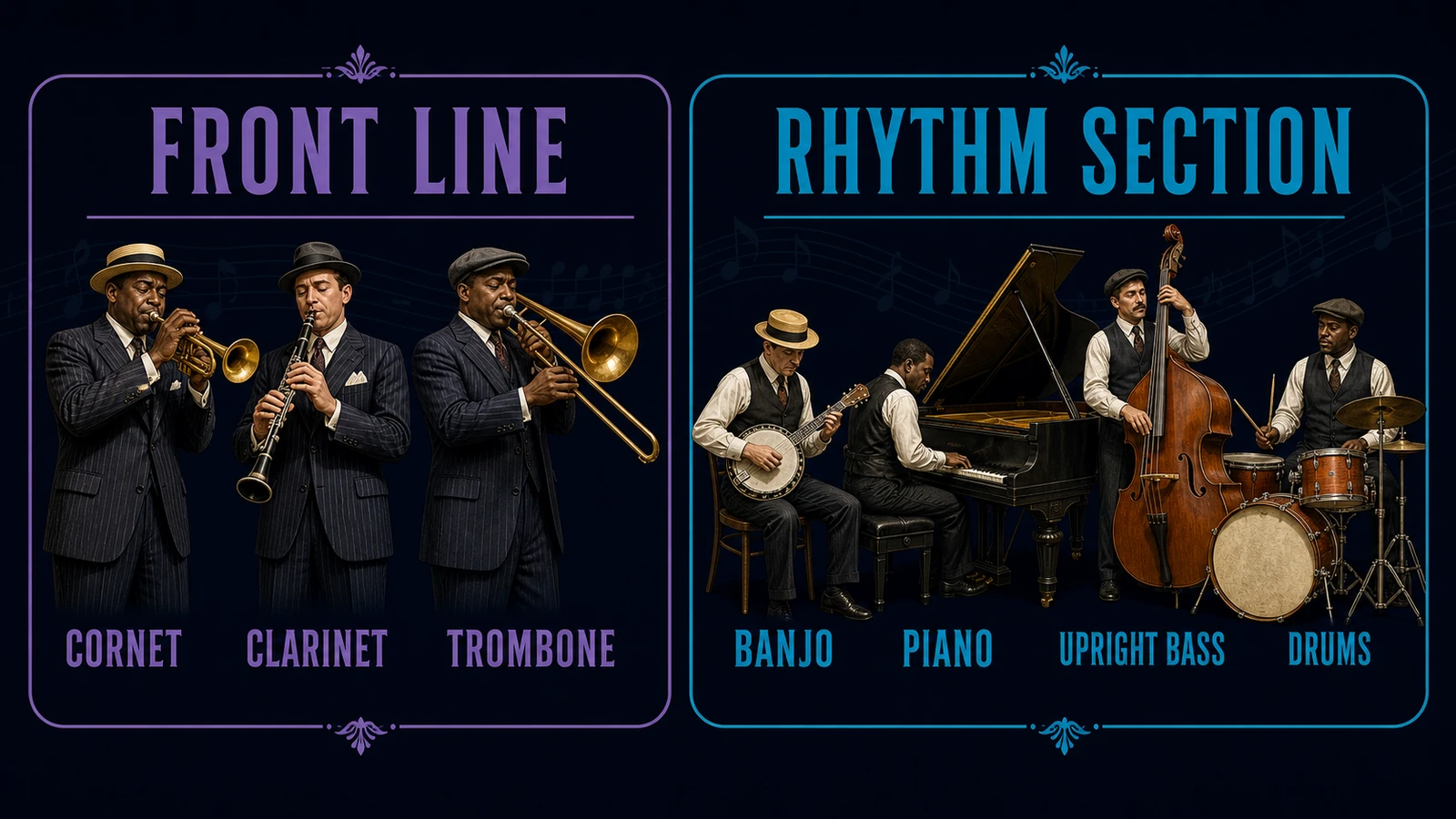
Build the band around two sections
Think in terms of a front line and a rhythm section, then adjust for the players and venue you actually have.
| Section | Instrument | Core job | What to listen for |
|---|---|---|---|
| Front line | Cornet or trumpet | Lead melody and phrase direction | Is the tune still recognizable when the texture thickens? |
| Front line | Clarinet | Upper countermelody and connecting motion | Does it complement the lead instead of shadowing every note? |
| Front line | Trombone | Lower counterline and punctuation | Is there enough space for bass movement and cadences? |
| Rhythm | Banjo or guitar | Chordal pulse and harmonic clarity | Is the subdivision buoyant rather than heavy? |
| Rhythm | Piano | Harmony, fills, introductions, and endings | Does it leave room when another chordal instrument is active? |
| Rhythm | Bass or tuba | Harmonic foundation and forward motion | Do roots and approaches make the form easy to follow? |
| Rhythm | Drums | Time, color, dynamics, and transitions | Can the band become softer without losing the pulse? |
This is a role map, not a rule that every performance needs seven musicians. A guitarist can replace banjo. A tuba can replace string bass, especially in parade or early-style settings. Piano may be unavailable at an outdoor job. A quartet can imply missing parts through register, rhythm, and phrasing.
Adjust the arrangement to the musicians you have
Smaller bands need clearer priorities. Larger bands need more restraint.
| Ensemble size | Practical lineup | Arrangement priority |
|---|---|---|
| Trio | Cornet, banjo or piano, bass or tuba | Keep melody, harmony, and pulse unmistakable; use breaks to create contrast |
| Quartet | Cornet, clarinet or trombone, chordal instrument, bass or tuba | Divide lead and counterline roles explicitly before improvising |
| Quintet | Two or three horns plus two or three rhythm players | Plan when the full front line enters and when it thins out |
| Six or seven pieces | Classic front line plus fuller rhythm section | Control register, chordal density, dynamics, introductions, and endings |
| Eight or more | Expanded horns or rhythm colors | Use written backgrounds and sectional contrast so the texture does not become continuous tutti |
If a player is missing, do not make every remaining musician play more all the time. Replace the missing function only where the tune needs it. Without trombone, the bass and piano can make lower harmonic movement more explicit. Without clarinet, the cornet can leave longer notes while piano or guitar supplies a light answer. Without drums, bass and banjo can make the pulse more consistent.
These decisions also depend on transposition. Clarinet and trumpet parts are often written for B-flat instruments, while an alto saxophone substitute may read in E-flat. The guide to transposing instruments explains how written and sounding pitch relate before you prepare or copy parts.
Choose repertoire that teaches the style
A strong first set should let the ensemble practice several kinds of musical work without requiring a completely new arrangement language for every tune.
Build around three or four repertoire functions:
- A medium-tempo ensemble number with a clear melody and predictable form. Use it to establish balance and collective phrasing.
- A blues-based tune that gives players room to hear call-and-response, repeated ideas, and harmonic direction.
- A lyrical or slower number that exposes intonation, breath support, and the quality of sustained counterlines.
- An up-tempo closer or parade-style number that tests endurance, dynamics, and the band's ability to keep the beat light.
- A feature for a singer or instrumentalist, arranged so the rest of the band supports the feature instead of competing with it.
Do not choose a tune only because a famous recording exists. Ask whether the band has a lawful score or lead sheet, whether the form is clear, whether the key suits the melody instrument or singer, and whether the arrangement leaves a distinct job for each player. The guide to finding free sheet music online includes practical source and copyright checks; “old song” does not automatically mean “free to copy in every edition or arrangement.”
For historical listening, compare several recordings of the same tune. Write down where the melody changes, when ensemble passages give way to solos, how the bass line moves, and what kind of ending the band uses. The goal is not to duplicate one performance note for note. It is to hear which choices define the tune and which belong to a particular band.
Pick the lightest chart that keeps everyone together
Traditional jazz can sound spontaneous while still relying on careful written preparation. The right chart is the least notation that prevents avoidable confusion.
| Chart type | Best use | Must include |
|---|---|---|
| Lead sheet | Familiar form, flexible instrumentation, experienced improvisers | Melody, chords, key, meter, form, essential hits |
| Chord chart | Rhythm-section rehearsal or a player who already knows the melody | Reliable harmony, bar lines, form, endings |
| Written parts | Specific counterlines, unfamiliar ensemble, arranged backgrounds | Clear transposition, cues, dynamics, rehearsal marks |
| Full score | Director-led rehearsal or a detailed original arrangement | Every sounding relationship the director must diagnose |
Berklee's explanation of how musicians use lead sheets is useful here: a lead sheet communicates melody, harmony, and essential structure while leaving performance decisions to the musicians. For a trad-jazz chart, also write what memory may not reliably preserve—an unusual introduction, stop-time chorus, ensemble break, modulation, tag, or final chord.
The separate guide to jazz music notation goes deeper into chord symbols, rhythmic notation, articulation, and readable parts. Use that level of detail when a rehearsal problem is genuinely notational. Do not over-notate swing feel or every improvised decoration simply because the software makes it possible.
Rehearse the band eight bars at a time
Full run-throughs reveal stamina and set flow, but they are inefficient for solving texture. Rehearse short sections until every player can name the job they are doing.
- Play only melody and bass so the form is unmistakable.
- Add banjo, guitar, or piano and agree on harmonic rhythm.
- Add one counterline instrument and balance its register against the melody.
- Add the remaining front-line voice with deliberate gaps rather than constant motion.
- Rehearse the last eight bars and ending before playing another complete chorus.
- Record one pass from the audience position and check whether melody, bass, and pulse remain clear.
- Mark one concrete change on the chart instead of relying on a long verbal correction.
During playback, listen for collisions at phrase beginnings and cadences. Those are the moments when several players naturally want to contribute. Assigning one player to begin the phrase and another to answer often creates more style than adding more notes.
Use Sheet2MIDI for a first-pass rehearsal file
If your band already has a clear printed or PDF chart, a MIDI reference can help verify pitches, hear inner parts, or prepare a slower rehearsal version. Melogen Sheet2MIDI accepts a score image or PDF and converts recognized notation into MIDI that can be opened in compatible music software.

Treat conversion as a first pass. Proofread notes, rhythm, repeats, transposition, voices, and endings against the source score before rehearsal. Complex layouts, handwritten markings, or unusual notation may need manual correction. The tool converts existing notation; it does not invent stylistically appropriate collective improvisation, voicings, backgrounds, or a complete traditional-jazz arrangement.
Turn a readable chart into an editable MIDI reference
Upload a PDF, PNG, or JPG score, then verify the converted notes, form, and transposition before rehearsal.
Traditional jazz bands FAQ
What instruments are in a traditional jazz band?
A classic lineup uses cornet or trumpet, clarinet, and trombone in the front line, supported by some combination of banjo or guitar, piano, bass or tuba, and drums. Real bands often use fewer players or substitutions. Preserve the musical functions—melody, counterline, harmony, bass, and pulse—rather than treating one lineup as mandatory.
Is traditional jazz the same as Dixieland?
The terms overlap, but they are not identical in every context. “Traditional jazz” can refer broadly to early New Orleans-derived ensemble styles and later revivals. “Dixieland” became a common label for related repertoire and instrumentation, but some musicians avoid it because of its commercial history and cultural associations. A specific description such as New Orleans jazz, classic jazz, or British trad is often clearer.
Does every player improvise at the same time?
Not continuously. Collective improvisation works when the instrumental roles remain distinct and players leave space. A tune can alternate arranged ensemble passages, collective textures, breaks, and featured solos. The band should still make the melody and form easy to follow.
Do traditional jazz bands need written arrangements?
Not always, but they need shared information. Experienced players may work from a lead sheet or known repertoire. Written parts become more useful for unfamiliar tunes, transposing instruments, specific introductions and endings, arranged backgrounds, or ensembles that do not share the same performance conventions.
How should a new band choose its first tunes?
Choose a small set with clear forms and contrasting jobs: a medium ensemble number, a blues-based tune, a lyrical piece, and a faster closer. Confirm the key, source, arrangement rights, and instrumentation. Pick music that teaches the band to balance melody, counterline, harmony, bass, and pulse before chasing a long repertoire list.
The practical takeaway
Traditional jazz bands work when separate roles produce one shared motion. Start with a melody-led front line and a rhythm section that makes harmony and pulse easy to hear. Then scale the arrangement to the musicians available, choose repertoire with distinct rehearsal value, and write only the details the band cannot reliably infer.
The style does not depend on copying one historic lineup or filling every bar. It depends on recognizable melody, responsive counterlines, rhythmic lift, and players who know when to lead, answer, support, or leave space. Get those relationships right, and even a small ensemble can sound complete.
About the author
Zhang Guo
Composer - AI Product Manager
AI product manager and digital marketing consultant with a background in music. Creativity is the bridge between rhythm and logic, where musical intuition and mathematical precision can coexist in every meaningful product decision.
Follow on X