How to Find the Key of a Song by Ear, Chords or Tools
Find a song's key from audio, by ear or from chords. Hear C major versus A minor, check AI results, and handle songs that change key.
 Zhang Guo
Turn a static score into editable MIDI
Contents
To learn how to find the key of a song, listen for the note or chord that feels like home, match it on a piano or guitar, then check whether the surrounding harmony supports a major or minor key. An audio analyzer can give you a candidate faster, but the useful final check is whether that answer fits the section you are hearing.
You do not need perfect pitch. You need a recording, a way to match a note, and a little patience at the end of a phrase. Here are three routes, including short listening examples you can try before analyzing your own track.
Choose a method from the source you have
A key usually tells you two things: the tonal center, such as C, and its quality, such as major or minor. Finding a note that fits is only the beginning; several notes may fit without being the center.
| What you have | Start here | How to check the answer |
|---|---|---|
| An audio file and a need for a quick starting point | Get a tonal-center estimate from an audio analyzer | Compare it with the bass, melody and chord arrivals |
| A recording and a piano or guitar | Hum the home note, then match its pitch | Test a major and minor chord built on that note |
| A reliable chord chart | Look for the chord that functions as home | Listen for where phrases settle, rather than counting chord names |
| Written notation | Read the key signature | Distinguish relative major and minor from the musical context |
If you are learning a guitar part, start with the recording you will actually play along with. A live performance, cover or pitch-shifted version may be in a different key from the original release.
Get a candidate key from the audio
Melogen Song Analyzer accepts uploaded audio or a direct audio-file URL. Its Harmony and style analysis includes an estimated tempo, tonal center and harmony information, alongside the broader song report.
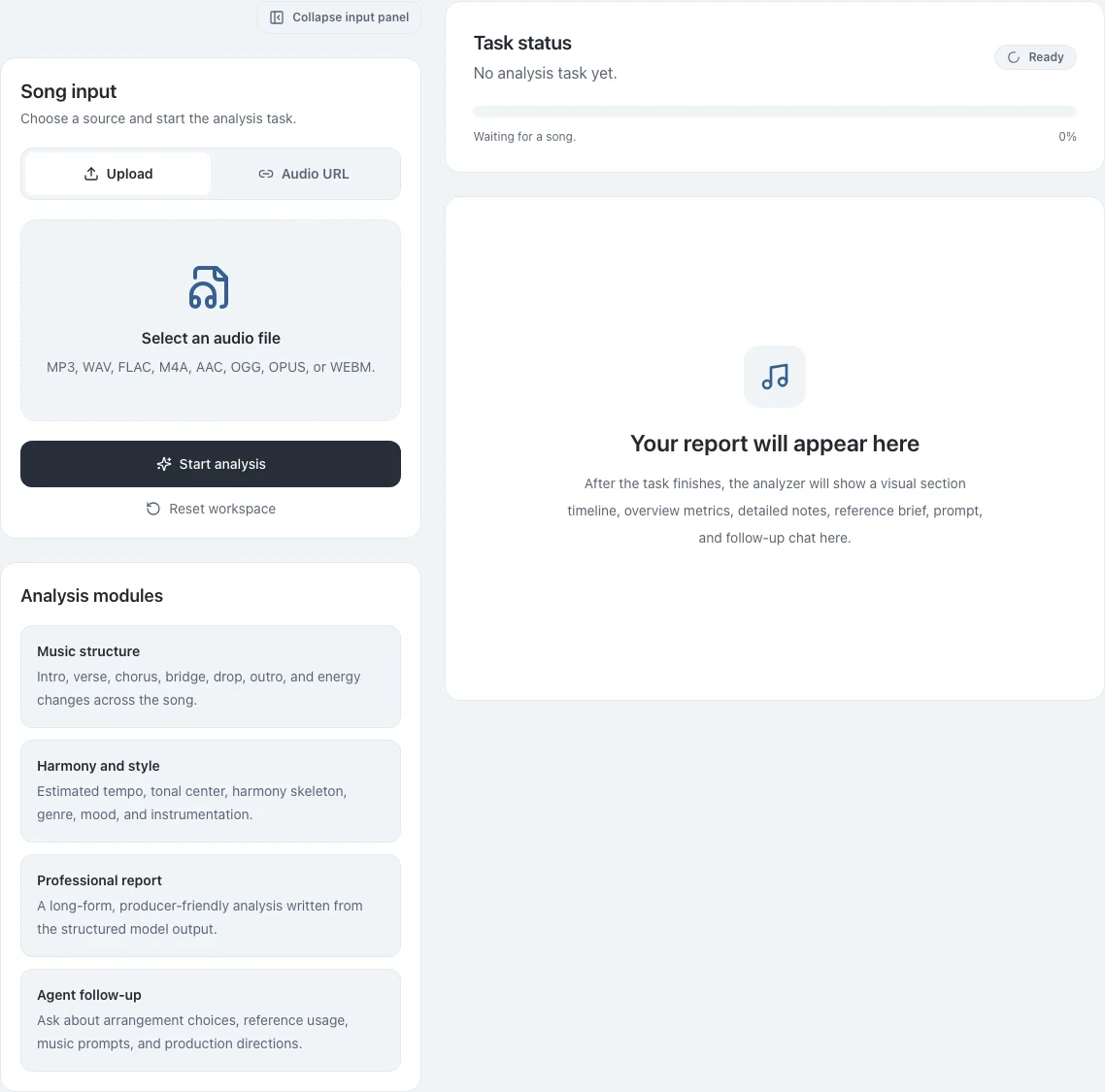
For a recording you have permission to use:
- Choose the audio file in the Song input panel, or supply a direct audio URL. Supported formats include MP3, WAV, FLAC and M4A.
- Start the analysis and wait for the report.
- Look for the tonal-center estimate and the harmony discussion. Write down the proposed key, including major or minor when given.
- Return to the recording. Check a clear verse or chorus using the listening and chord tests below.
A general streaming-service page is not the same as a direct audio URL. Use an actual audio file rather than assuming any Spotify or YouTube link will work. Check the current preview, subscription and credit terms on the tool page before starting.
Get a starting point for your key check
Upload a recording to Melogen Song Analyzer, then compare its tonal-center estimate with what you hear in the song.
Find the home note by ear
Choose a passage with a clear melody and accompaniment. A drum-only intro gives you little evidence about key; a settled phrase in a verse or chorus is more helpful.
Try this sequence:
- Listen to the whole phrase without playing anything.
- Hum the note that would make the phrase feel finished. You are looking for a resting point, not necessarily the highest or loudest note.
- Keep humming while you find the same pitch on a keyboard or guitar. Moving it up or down an octave is fine.
- Play a major chord built on that note, then a minor chord. Compare both with the recording, especially at a phrase ending.
- Repeat in another phrase. If the same center keeps making sense, you have a stronger candidate.
Suppose you keep humming E. Test E major and E minor, then listen for how the melody treats G-sharp versus G-natural. The surrounding chords matter too: one melody note on its own does not settle the question.
If everything sounds wrong, first check your pitch match. A sharp or flat error at this stage can send the rest of the analysis in the wrong direction. Older recordings and altered playback speeds may also sit between the pitches of a normally tuned instrument.
Check the chords before naming the key
If you know the chords, look at how they behave over time. The tonic chord is the one that acts as home; it does not have to appear first or occur most often.
For a simple C–F–G–C phrase, the return from G to C supports C major. If the melody also settles on C, those two clues reinforce each other. By contrast, a loop containing C, G, Am and F is not enough by itself to decide between C major and A minor. Listen for the melody, bass and phrase boundaries.
Use a small evidence checklist:
- Which chord sounds like a place where the phrase could stop?
- Does the bass support that arrival?
- Does the melody settle on the same center or a stable note of its chord?
- Does the next phrase keep that center, or immediately suggest another one?
In minor-key music, a major dominant can be especially helpful. E or E7 moving to Am supports an A-minor reading; the G-sharp in that E chord leads toward A. That does not mean every A-minor song must contain E7. The minor-key explanation in Music Theory for the 21st-Century Classroom shows why minor music can use raised notes beyond its key signature.
Hear the difference between C major and A minor
C major and A natural minor use the same seven note names: C, D, E, F, G, A and B. They organize those notes around different centers. A list of pitches therefore cannot always tell you which key you are hearing.
These two original teaching examples use only those white-key notes. Each has four chords at the same tempo, with a bass note under each chord and a longer final chord. Listen at a comfortable volume and notice the destination of each phrase.
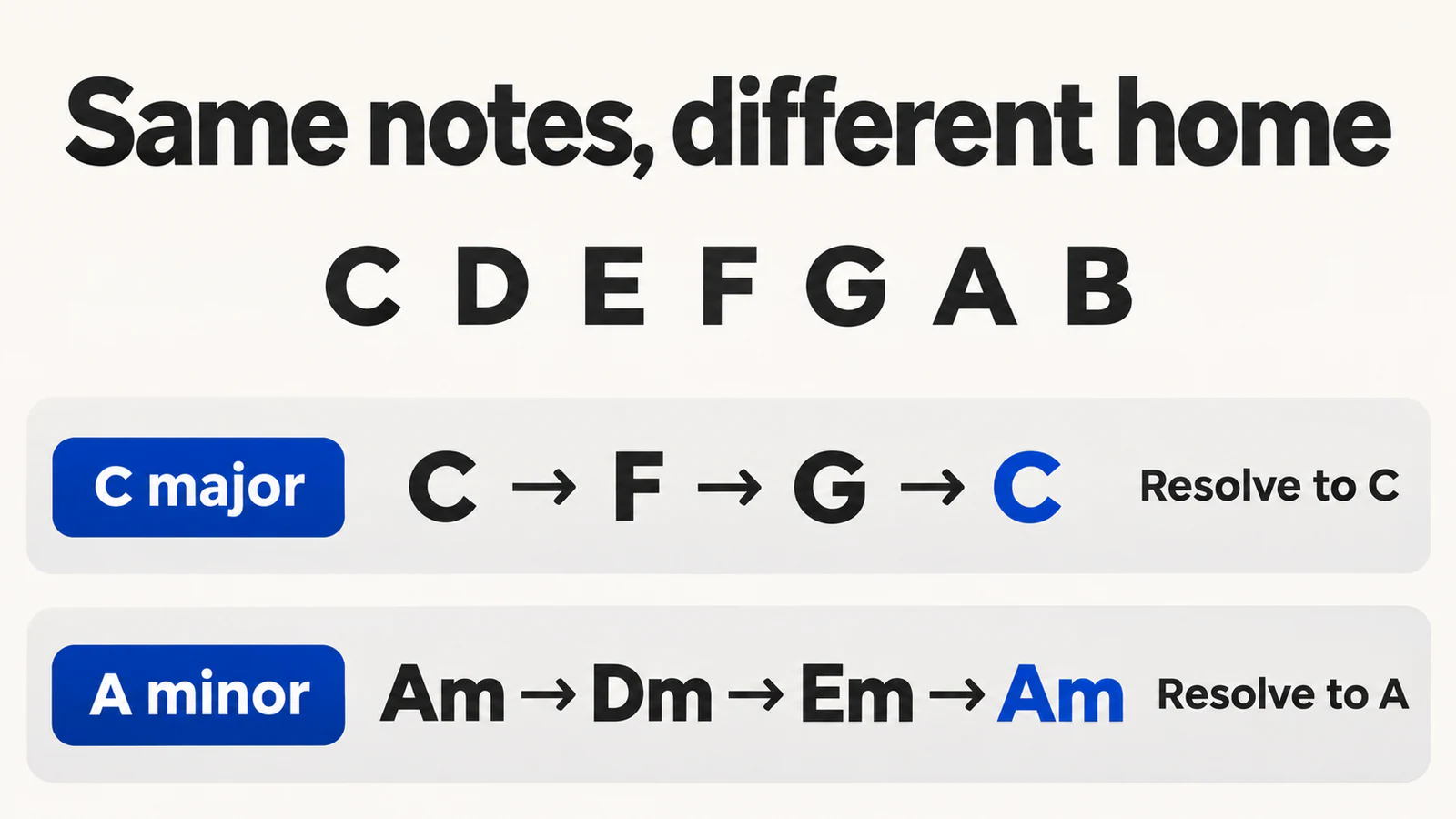
Example 1 — C major: C → F → G → C. Listen for the final C chord as the arrival.
Example 2 — A minor: Am → Dm → Em → Am. Listen for the return to A in the bass and the final A-minor chord.
The minor example deliberately uses Em rather than E major, so it introduces no G-sharp. The different arrival still establishes an A-minor context. In a real song, melody, rhythm and arrangement add further evidence.
Try humming the home note after each clip ends, then find it on your instrument. That is a more useful exercise than labeling a track from its emotional mood: a sad lyric can sit over major harmony, and a minor-key song can sound energetic.
Resolve disagreements between tools and sections
Two different answers are a reason to inspect the music more closely. They do not automatically mean you chose the wrong tool.
| What you notice | What to check next |
|---|---|
| One answer says C major and another says A minor | Compare the tonal center at phrase endings; the underlying note collection overlaps |
| The verse fits one key and the chorus fits another | Check each section separately and note where the change happens |
| One chord contains an unexpected sharp or flat | Look for a borrowed chord or temporary emphasis before renaming the whole key |
| Your instrument clashes with the whole recording | Check tuning, playback speed and whether you are using the correct version |
| There is no convincing major or minor center | Consider a modal, ambiguous or largely unpitched passage; leave the label qualified |
A modulation establishes a new tonal center; a passing chord can point elsewhere briefly without moving the whole song into a new key. The distinction is developed in the open textbook Fundamentals, Function, and Form.
For practical notes, write something like “verse centered on E minor; chorus centered on G major” when the recording supports that reading. It is more useful than forcing a single whole-track answer onto every section.
Before calling your answer finished, confirm that you have checked the exact recording, named both the center and its quality where clear, and listened to more than one phrase. If your next step is moving the song into a singer's range, continue with the step-by-step guide to transposing music.
Use sheet music when you have it
A key signature narrows the possibilities, but a major key and its relative minor share that signature. You still need the musical context to choose between them. An arrangement may also be transposed from the recording you are hearing.
For that notation-first workflow, use the separate guide to telling what key sheet music is in. Keep the score and recording aligned before treating one as confirmation of the other.
FAQs about finding a song's key
Can I find a song's key without perfect pitch?
Yes. Match a hummed note on a piano, guitar or other pitch reference, then examine its role in the phrase. Perfect pitch is not required to compare what you hear with a reference note.
Is the first chord always the key?
No. A song can begin away from its tonic, and a repeating loop may make its center ambiguous. Phrase endings, melody and bass give you additional evidence.
Can I find the key from a YouTube or Spotify song?
You can listen and use the ear-based method. For an upload-based analyzer, use a permitted audio file or a supported direct audio URL; do not assume a streaming page link is accepted. Make sure you are checking the same version of the song.
What if a song has more than one key?
Name the relevant sections and their centers rather than hiding the change. If the evidence stays ambiguous, record the alternatives and the passage you checked instead of presenting a guess as certain.
About the author
Zhang Guo
Composer - AI Product Manager
AI product manager and digital marketing consultant with a background in music. Creativity is the bridge between rhythm and logic, where musical intuition and mathematical precision can coexist in every meaningful product decision.
Follow on X