String Quartet Guide to Roles Rehearsal and Listening
Learn what a string quartet is, how four parts share musical roles, how to listen and rehearse, and where score-to-MIDI practice can help.
 Zhang Guo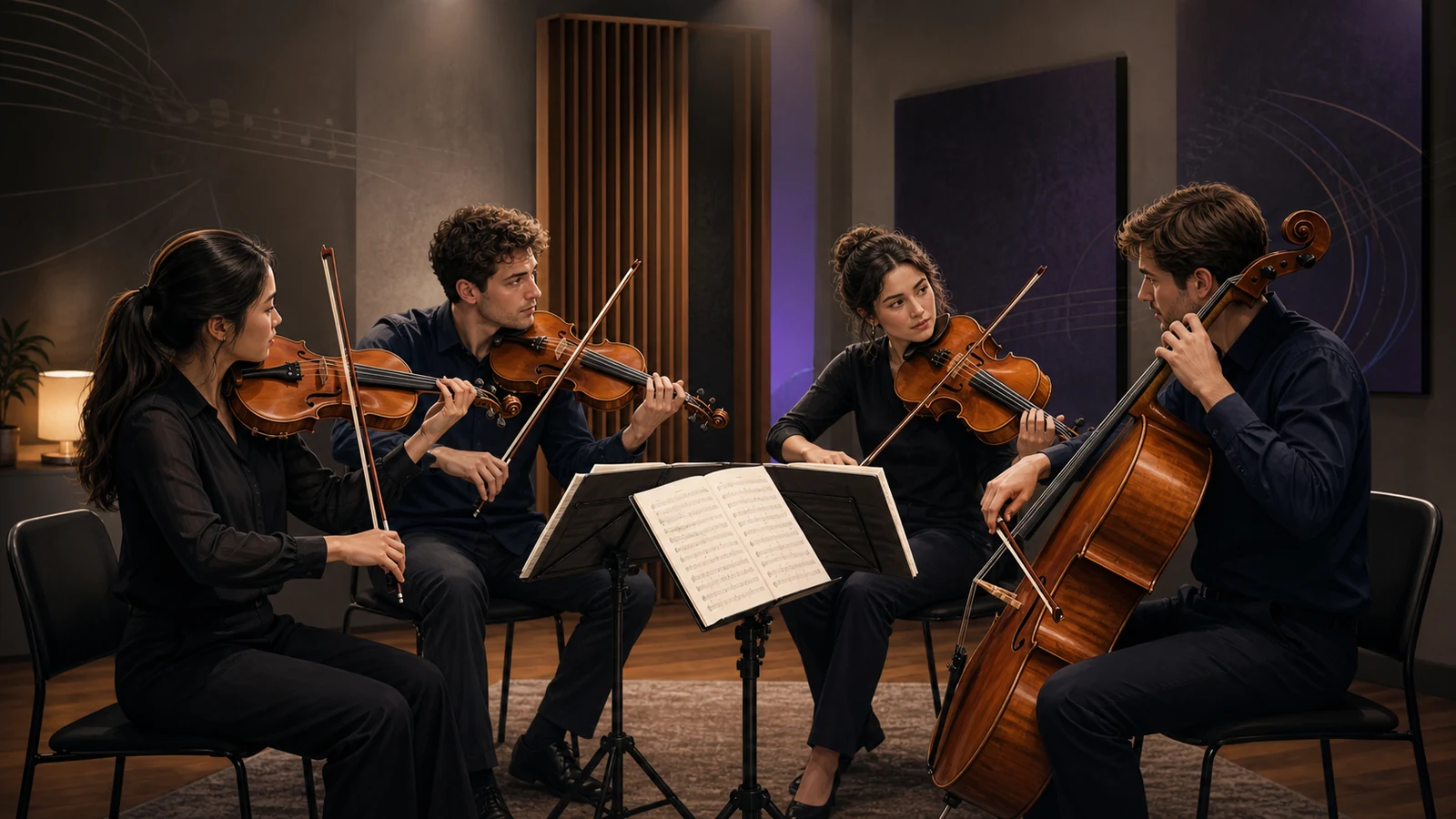
Turn a static score into editable MIDI
Contents
A string quartet is both an ensemble and a kind of music written for four bowed-string parts. The standard group uses two violins, one viola, and one cello. Those instruments cover a wide register without a conductor, so the players must share timing, phrasing, balance, and musical leadership from inside the group.
That is the useful distinction: a string quartet is not simply four soloists playing at once. It works through changing relationships. The first violin may introduce a melody, the viola may turn an inner rhythm into the pulse, the cello may move from bass foundation to a singing line, and the second violin may carry the handoff that keeps the whole phrase alive.
What makes a string quartet?
The standard instrumentation is:
- Violin I — usually the highest part.
- Violin II — another violin part in the same basic range, often with a different musical function.
- Viola — the darker middle voice between violin and cello.
- Cello — the lowest voice, with enough range to provide bass, counterpoint, or melody.
Carnegie Hall's educational quartet material uses the same two-violin, viola, and cello definition. The term can refer to the four performers, the ensemble itself, or a composition written for that combination.
Do not confuse a string quartet with every group of four string players. A piano quartet normally adds piano to violin, viola, and cello. Four violins form a different ensemble. A string orchestra may use the same instrument families, but it usually has multiple players on each part and often adds double bass.
The standard quartet has one player per part. That exposed setup is why balance and cueing matter so much. There is no section colleague to reinforce an entrance, and usually no conductor to repair a disagreement about tempo in real time.
Hear four roles instead of four instruments
The instrument names stay fixed, but their musical jobs change from phrase to phrase. Treat these as starting tendencies, not permanent assignments.
| Part | Common starting role | What the player should listen for | Common rehearsal trap |
|---|---|---|---|
| Violin I | Upper melody, lift, or visible cue | Bass direction, inner rhythm, and phrase handoffs | Leading every passage as if it were a solo |
| Violin II | Dialogue, imitation, pulse, or shared melody | Violin I articulation and viola's inner movement | Playing safely underneath instead of engaging |
| Viola | Inner color, harmonic motion, rhythmic hinge | Which outer voice the middle line currently supports | Disappearing because the line looks secondary |
| Cello | Bass foundation, harmonic arrival, or melody | Note length above the bass and the ensemble's release | Treating every bass note as equally heavy |
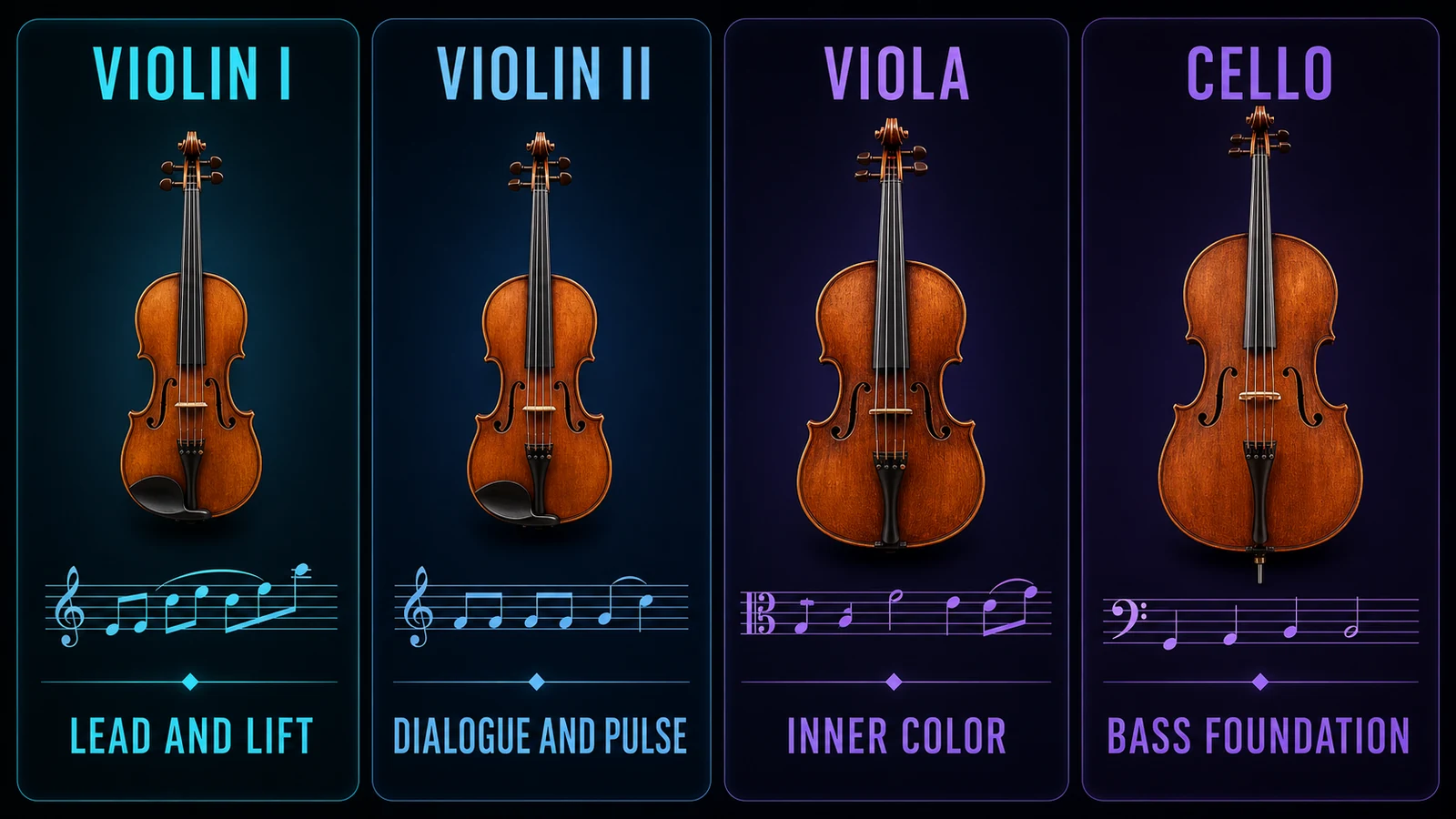
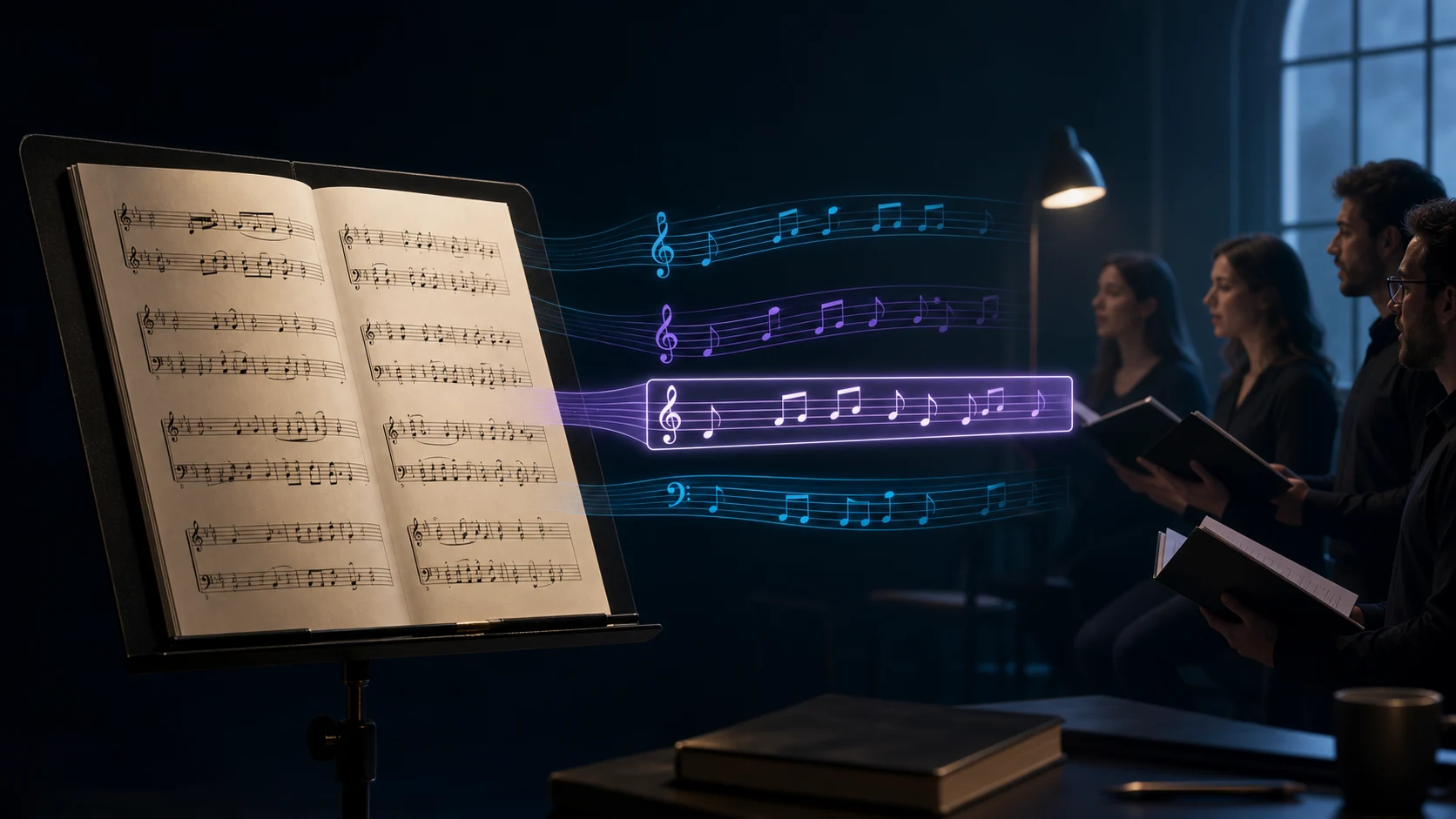
A better role map uses musical functions such as melody, bass, pulse, counterline, answer, and cue. Write those functions above important passages in the score. If the melody moves from cello to first violin through two bars of viola imitation, every player should be able to describe that route.
This approach also prevents a common hierarchy mistake. Violin I is not automatically the leader of every musical decision, and Violin II is not a reduced version of Violin I. In a strong quartet, leadership moves to the player whose line controls the next event.
Why the quartet sounds like a conversation
Four related instruments can blend as one body, but they also remain distinct enough to exchange ideas. Composers use that tension in several recurring textures:
- Melody with accompaniment. One voice is foregrounded while the others shape harmony, pulse, and direction.
- Imitation. A motif enters in one instrument and passes through the group.
- Homorhythm. All four parts move together, turning coordinated attacks and releases into the main expressive event.
- Counterpoint. Several independent lines remain active at once.
- Dovetailing. One player completes a gesture that another player began.
- Register exchange. A normally supporting voice moves into an exposed range while the upper instruments step back.
Listen for the moment the texture changes. A passage may begin as first-violin melody over accompaniment, then become four equal imitative voices two bars later. If the players keep the original balance, the audience hears the notes but misses the change in argument.
The same role-first thinking helps other small ensembles. The rehearsal framework in our guitar duet guide also starts by identifying melody, pulse, cue, and handoff responsibility before polishing tone.
How the string quartet became a major form
Music for four bowed strings developed gradually during the eighteenth century. The Library of Congress overview of Mendelssohn's Octet notes that the quartet of two violins, viola, and cello developed through the second half of that century and had become a central chamber-music form by the early nineteenth century.
Joseph Haydn did not create the idea from nothing, but his long engagement with the medium helped establish the quartet as four responsive partners rather than a melody with three anonymous supports. Oxford's study of Haydn's string quartets highlights their changing textures, motivic development, formal variety, and continuously shifting relationships among the instruments.
Mozart deepened the conversational balance. Beethoven used the quartet for public drama, formal experiment, and intensely private expression. Schubert expanded its lyric and harmonic scale. Later composers carried the ensemble into Romantic, modernist, folk-influenced, minimalist, electronic, and contemporary concert languages.
The instrumentation stayed remarkably stable while the musical possibilities widened. That makes the quartet a useful listening laboratory: the sound source remains familiar, so changes in texture, harmony, rhythm, form, and instrumental relationship are easier to hear.
How to listen to a string quartet
Do not try to follow every note in the first pass. Use three focused listens.
First listen for the large shape
Notice tempo, energy, major returns, and changes in texture. Ask when the ensemble feels like one block and when it sounds like four speakers. Mark the places where the music clearly turns, pauses, accelerates, or changes character.
Second listen for the bass and the handoffs
Follow the cello until another voice takes over the structural weight. Then track the melody as it moves. A handoff may be obvious, or it may pass through an inner part before reaching the next foreground voice.
Third listen for the middle
Focus on Violin II and viola. Inner parts often reveal the rhythmic mechanism, harmonic change, or imitative link that the outer voices make easy to overlook. If a passage suddenly feels more urgent, the cause may be a repeated inner figure rather than a louder top line.
Keep the score nearby when possible, but do not stare at it continuously. Alternate between seeing the parts and listening without visual help. The goal is to connect notation with audible relationships, not to turn listening into note checking.
Read the score before rehearsing the parts
Individual parts show what one player must perform. The full score shows why that material exists. Before the first rehearsal, each player should inspect the score and mark:
- important melody transfers;
- shared pickups and releases;
- rests that contain another player's cue;
- places where voices cross or share a register;
- tempo changes, fermatas, and rubato zones;
- repeated figures that establish pulse;
- recovery bars where the quartet can rejoin after a mistake.
Confirm that everyone uses the same edition and bar numbering. Bowings, rehearsal letters, page turns, and even measure numbers can differ across editions. A beautifully prepared part is not useful if its cues do not match the other three copies.
Public-domain libraries such as the IMSLP string quartet category can help with repertoire and score study. Check the license and copyright status of the exact edition, arrangement, and recording you use; an old composition does not make every modern edition unrestricted.
Rehearse problems in short musical loops
Full run-throughs reveal structure and endurance, but they are a slow way to repair ensemble relationships. Use a short loop that includes at least one bar before and after the problem.
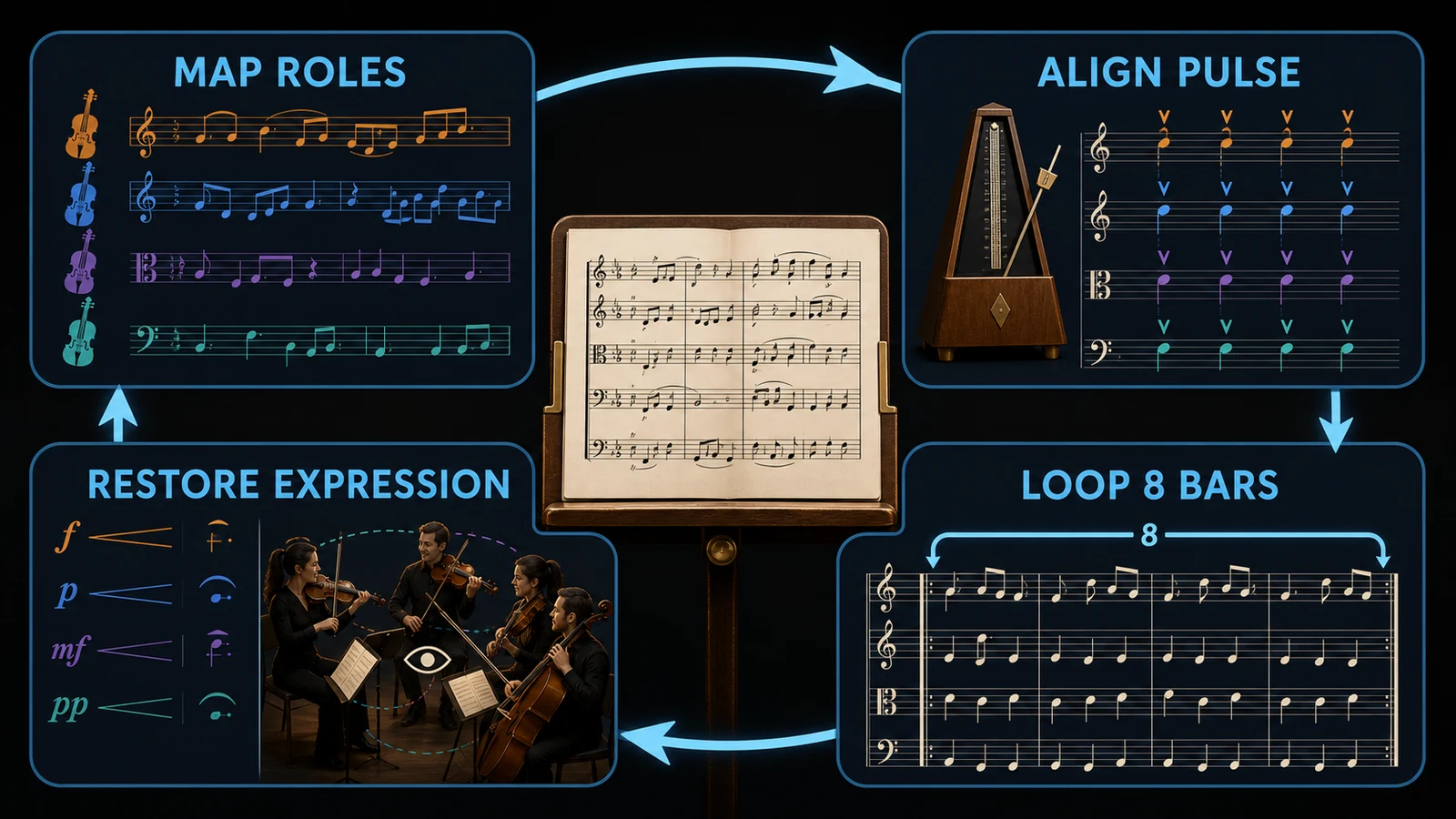
- Map roles. State who carries melody, bass, pulse, counterline, and the next cue.
- Align pulse. Count or tap the subdivision, then play with reduced dynamics and minimal rubato.
- Loop eight bars. Repeat a complete musical unit slowly enough to hear every relationship.
- Restore expression. Add dynamics, articulation, vibrato choices, bow character, eye contact, and flexible timing one variable at a time.
Use the sound of the failure to choose the next fix:
| What the quartet hears | Likely cause | Focused repair |
|---|---|---|
| Chords land almost together | Different subdivisions or unclear visual cue | Speak subdivisions and rehearse attacks without full tone |
| Melody disappears inside active texture | Balance still reflects an earlier role map | Name the foreground voice and reduce competing articulation |
| One player enters late after a rest | The rest was counted without an audible cue | Mark the cue note and sing or tap it during the rest |
| Ritardando becomes a four-way argument | Nobody owns the rate of change | Assign one visible leader and agree on the smallest pulse |
| Intonation drifts in held harmony | Players tune vertically without tracking motion | Identify the harmonic arrival and tune from bass upward |
| A motif loses energy at each handoff | Players match notes but not gesture | Rehearse the overlap, bow speed, and release as one phrase |
Three controlled repetitions are usually more informative than ten automatic ones. When the loop works, widen it. Do not immediately jump from eight stable bars to a complete movement.
Practice one part without losing the quartet
Private practice should prepare the relationship, not only the notes. Start by marking every entry that depends on another instrument. During rests, count through the other part's rhythm or sing the cue. At important handoffs, write the arriving instrument's note name or rhythm above your staff.
Useful solo-practice methods include:
- clap the shared pulse while speaking your rhythm;
- sing the bass line before playing an upper part;
- play only cue notes and structural arrivals;
- record a slow reference that leaves your own part silent;
- start from several recovery bars instead of always starting at bar one;
- rehearse releases, breaths, and page turns without playing the whole phrase.
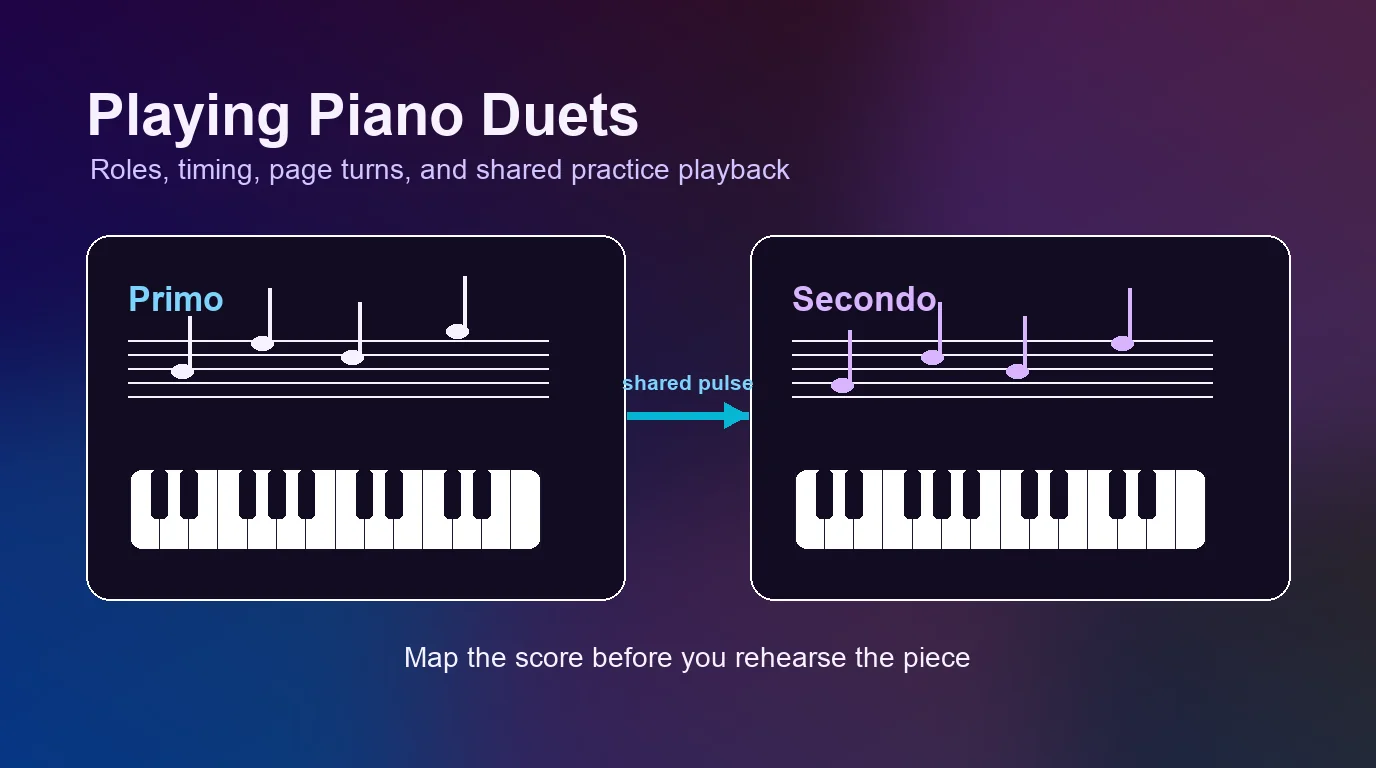
Playback can expose timing and note relationships, but it should not become a model for quartet expression. The same limitation applies in piano duet practice: a reference can preserve context, while actual ensemble decisions still depend on listening and response between players.
Where Melogen fits in quartet score study
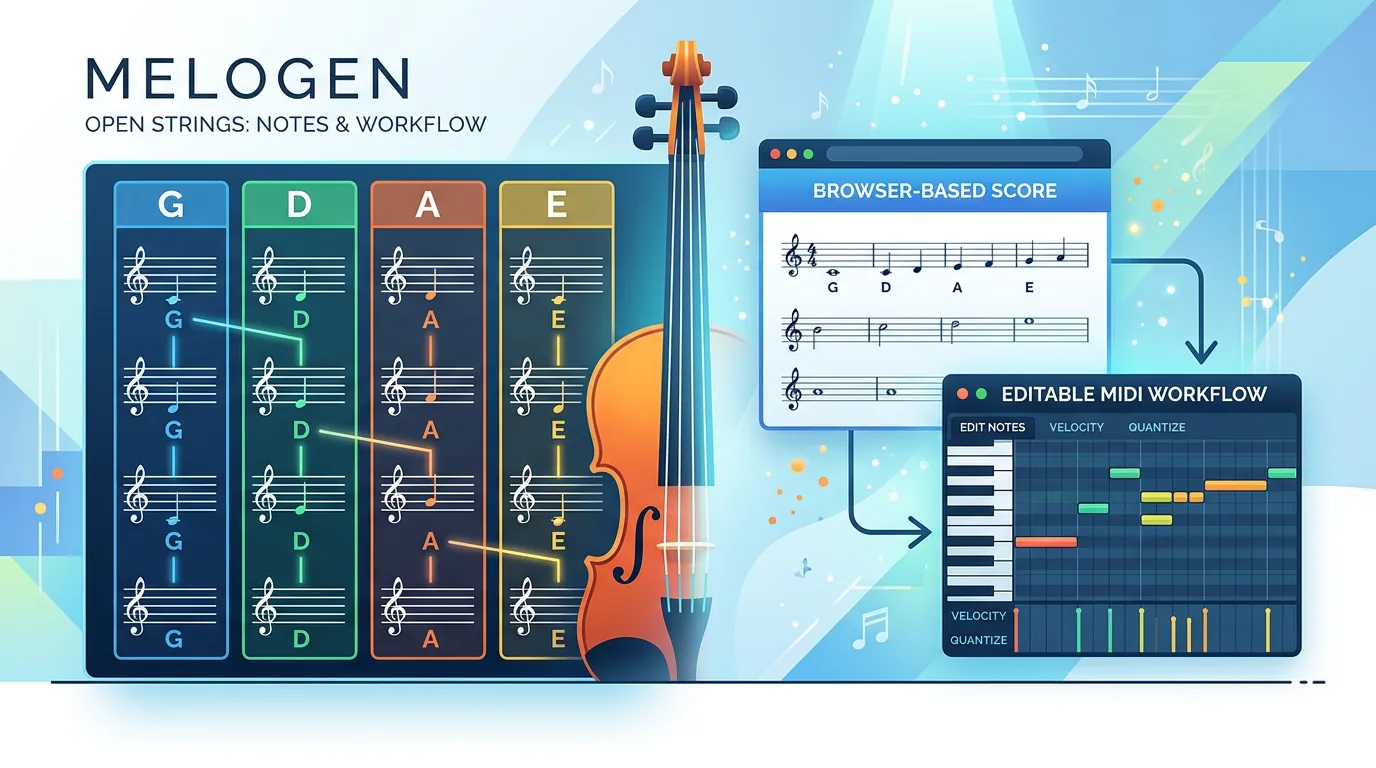
If you have a clear printed or digital score, a first-pass MIDI reference can make part relationships easier to inspect before rehearsal. The current Melogen Sheet2MIDI workflow accepts PDF, JPG, and PNG score sources and produces editable MIDI output.

Use Melogen Sheet2MIDI for bounded study jobs:
- hear the written parts together at a steady tempo;
- inspect entrances and handoffs away from the instrument;
- move a first-pass MIDI file into a DAW or notation workflow;
- slow a passage after import without re-entering every note;
- identify obvious recognition errors before using the file as a reference.
Start with a short, clean passage. Check notes, rests, bar alignment, voices, repeats, tempo, and track structure against the score. Dense divisi, handwritten markings, poor scans, unusual notation, or complicated page geometry can require manual cleanup.
Melogen does not replace quartet rehearsal, decide bowings, judge intonation, or automatically create a polished music-minus-one track. It also does not publish a quartet-specific part-isolation guarantee. Treat the MIDI as editable reference material. Our full sheet music to MIDI workflow explains how to validate the first pass before relying on a longer conversion.
Turn a clear quartet score into an editable MIDI reference
Use Melogen Sheet2MIDI for a first pass, verify every important relationship against the score, then make timing, balance, and expression decisions with the quartet.
Use this quartet rehearsal checklist
Before a focused rehearsal, confirm:
- Everyone has the same edition, bar numbers, and rehearsal letters.
- Each player can name melody, bass, pulse, and cue roles in the target passage.
- Entrances after long rests have an audible or visible cue.
- Bowings and articulations agree where the group forms one gesture.
- Balance follows the current musical function, not the printed part number.
- Tempo changes have one visible leader and a shared subdivision.
- At least two recovery bars are known in each movement.
- The group has rehearsed releases and silence as carefully as attacks.
- Playback or MIDI references have been checked against the printed score.
- The final run uses performance seating, stands, page turns, and spacing.
String quartet questions
What instruments are in a string quartet?
The standard string quartet uses two violins, one viola, and one cello. The name can describe both the ensemble and music written for that instrumentation.
Is Violin I always the leader?
No. Violin I often carries exposed upper material and may give visible cues, but musical leadership should move with the active line, pulse, bass, or transition. Quartets also make practical leadership decisions differently.
Is Violin II easier than Violin I?
Not necessarily. Violin II may sit lower, but it often controls difficult inner rhythms, imitation, tuning, and handoffs. Difficulty depends on the piece and the role of the passage, not the part number.
How can one player practice a quartet part alone?
Mark cue notes, count through rests, sing other parts, use short loops, and keep the full score nearby. A checked playback or MIDI reference can supply context, but it cannot replace responsive ensemble rehearsal.
Can Melogen isolate one quartet part automatically?
The safe current claim is narrower: Sheet2MIDI converts clear PDF, JPG, or PNG notation into editable MIDI. Track structure depends on the source and conversion result, so verify the file before building any part-muted practice workflow.
The practical takeaway
A string quartet is four related instruments acting as a flexible musical system. Learn the standard instrumentation, but listen beyond the labels. Track melody, bass, pulse, inner motion, cue responsibility, and the points where those jobs change.
Then rehearse relationships instead of repeatedly running the piece. Read the full score, mark handoffs and recovery bars, repair eight-bar problems, restore expression only after the pulse is stable, and use playback as a checked reference rather than a performance model. That is how four prepared parts become one responsive ensemble.
About the author
Zhang Guo
Composer - AI Product Manager
AI product manager and digital marketing consultant with a background in music. Creativity is the bridge between rhythm and logic, where musical intuition and mathematical precision can coexist in every meaningful product decision.
Follow on X