Types of Singing Voices and Vocal Ranges Explained
Learn the main types of singing voices, vocal range, tessitura, and timbre so you can choose parts, practice smarter, and use Melogen well.
 Zhang Guo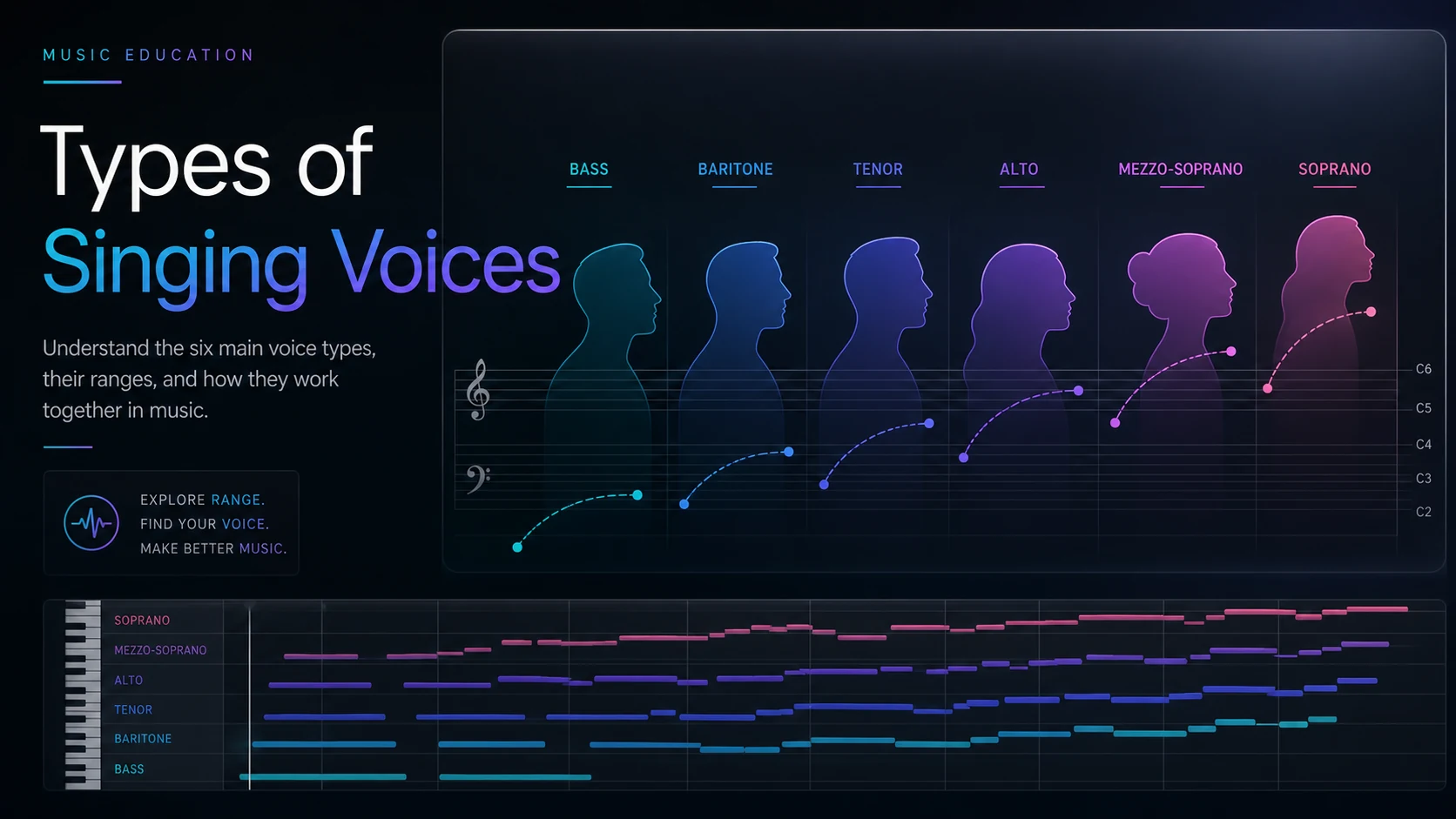
Turn a static score into editable MIDI
Contents
The main types of singing voices are usually grouped as soprano, mezzo-soprano, contralto or alto, tenor, baritone, and bass. Those labels are not just high-to-low buckets. A useful voice type combines range, tessitura, timbre, passaggio, and the musical role a singer can carry comfortably.
That last word matters: comfortably. A singer might touch a high note once, but that does not mean the voice lives there. Good classification is less about proving the highest or lowest note on a good day and more about finding the part where tone, stamina, text, and musical line still work.
Start with what voice type actually means
A voice type is a practical way to describe where a singer's voice sits and how it behaves. Classical and choral traditions use these labels so composers, directors, teachers, and singers can match a voice to parts that make musical sense.
The Kennedy Center's voice-type explainer and OperaVision's voice types guide both frame the idea around opera and ensemble roles. That is a good starting point, but it is not the whole story for modern singers. Pop, worship, musical theatre, barbershop, jazz, and studio vocals all use range differently.
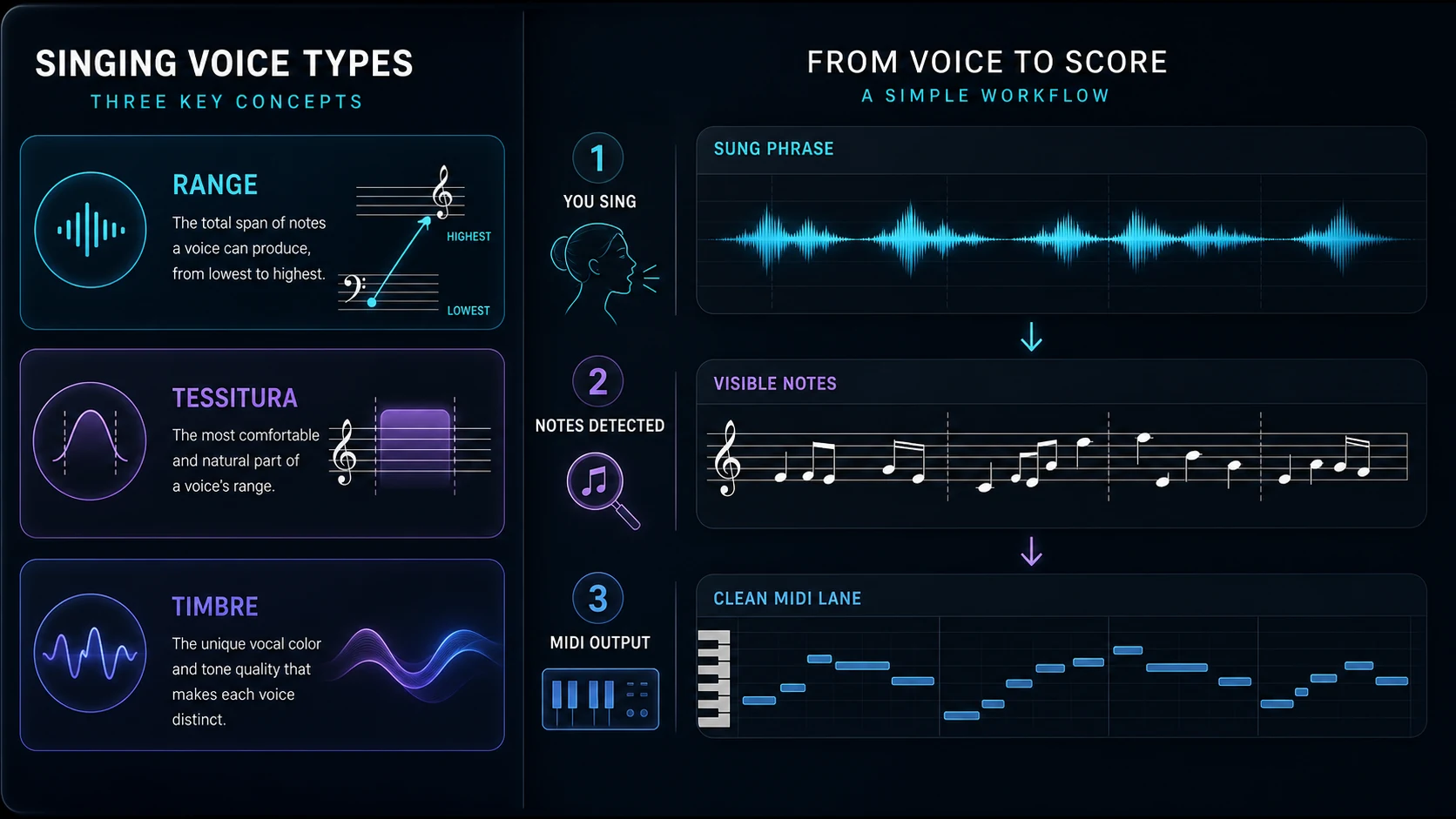
The useful distinction is this:
| Concept | What it means | Why singers should care |
|---|---|---|
| Range | The total span of notes a singer can produce | It shows the outer limits, but not the best everyday part |
| Tessitura | The most comfortable and resonant zone | It predicts where a singer can rehearse, perform, and stay expressive |
| Timbre | The color or weight of the sound | It helps separate two voices with similar ranges but different roles |
| Passaggio | The transition area between registers | It affects where a line feels easy, exposed, or technically demanding |
| Role | The job the part does in an ensemble or song | It decides whether the voice carries melody, harmony, color, or foundation |
If you only check range, you can mislabel a voice quickly. A lyric baritone may reach some tenor notes, and a mezzo-soprano may sing a soprano line for a short phrase. The better question is where the voice sounds healthy, stable, and expressive across a real piece.
Compare the main singing voice categories
Voice ranges vary by singer, training, age, repertoire, and style. Treat the ranges below as common landmarks, not audition rules.
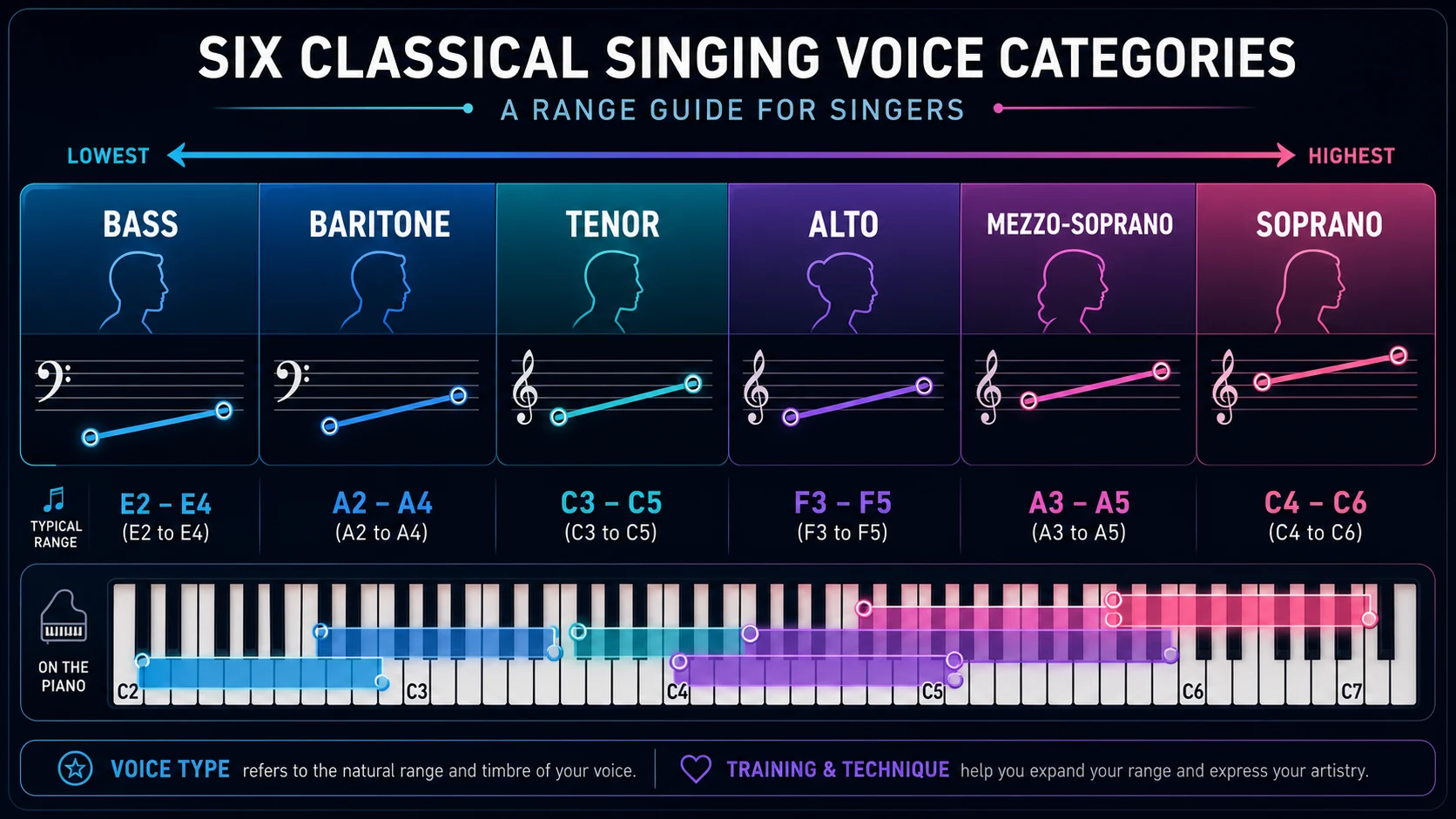
| Voice type | Typical role | Common range landmark | Practical listening cue |
|---|---|---|---|
| Soprano | Highest common treble voice | Around C4 to C6 | Bright top line, often melody or high color |
| Mezzo-soprano | Middle treble voice | Around A3 to A5 | Warmer center, flexible between lyric and dramatic roles |
| Contralto or alto | Lower treble voice | Around F3 to F5 | Darker color, strong lower register, often inner harmony |
| Tenor | Higher common lower voice | Around C3 to C5 | Clear upper extension, often melody in male-voice settings |
| Baritone | Middle lower voice | Around A2 to A4 | Balanced weight, strong speech-like center, flexible harmony role |
| Bass | Lowest common lower voice | Around E2 to E4 | Low foundation, depth, and harmonic anchor |
Countertenor also matters, especially in early music and some contemporary writing. It is usually a higher lower-voice category that uses a developed upper register rather than simply sitting inside tenor or alto in the same way every time.
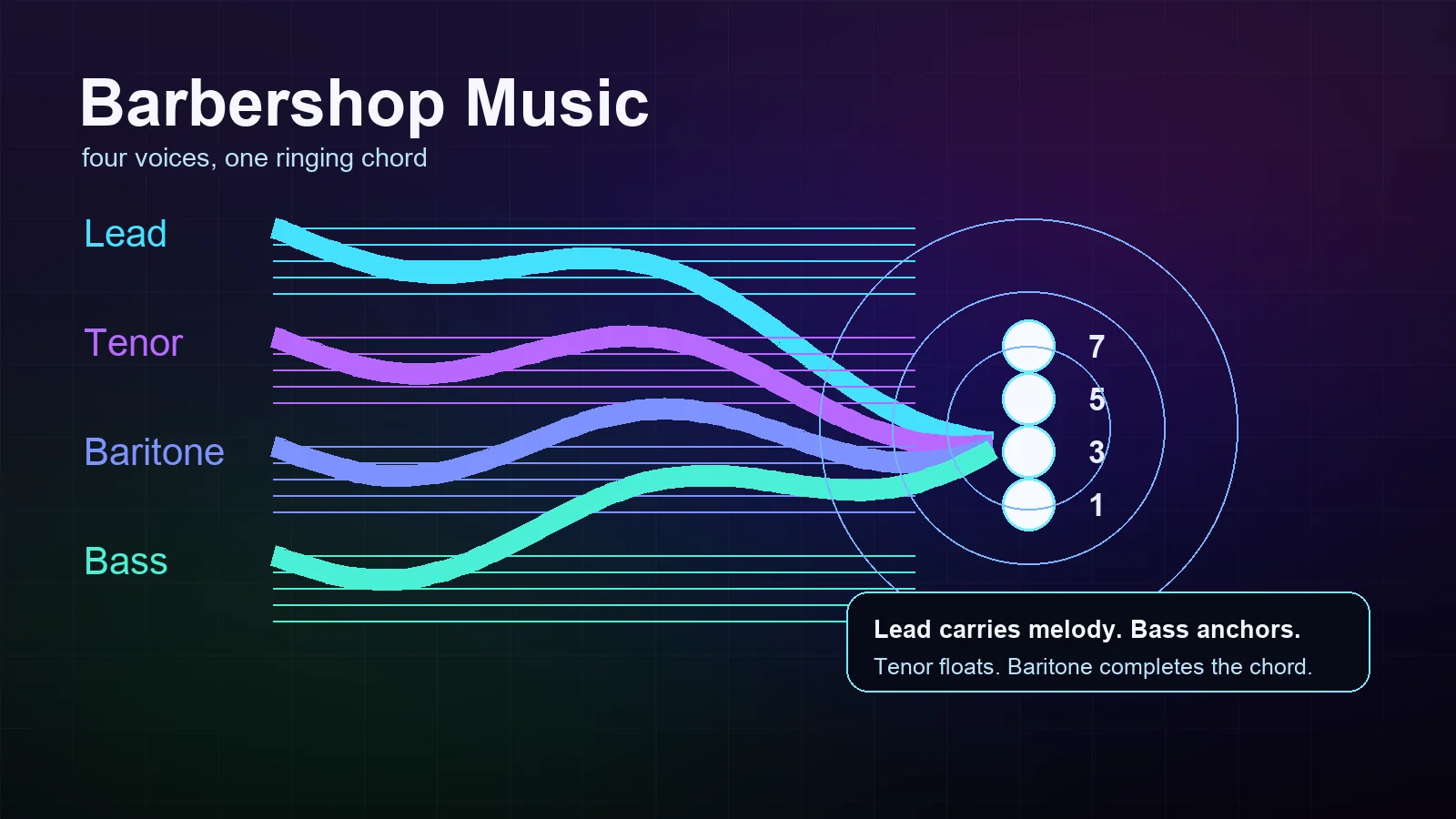
For ensemble music, the exact label matters less than the function. In choral music, SATB writing often divides singers into soprano, alto, tenor, and bass sections. In barbershop music, the roles are tenor, lead, baritone, and bass, and the lead often carries the melody inside the texture instead of at the top.
Use range, tessitura, and tone together
If you are trying to classify your own voice, do not start by chasing extreme notes. Start with a short piece, a comfortable key, and a clean recording.
Try this simple self-check:
- Sing a five-note scale in a comfortable middle register.
- Move up by half steps until the tone becomes tense, thin, or unreliable.
- Move down by half steps until the tone becomes pressed, breathy, or hard to tune.
- Mark the notes that still sound musical, not just technically possible.
- Sing a real melody and notice where the words, vowels, and breath stay natural.
- Repeat on a different day before making any decision.
The real clue is often tessitura. If a song sits too high for too long, the voice may feel fine for one chorus and tired by the bridge. If it sits too low, the singer may lose projection and diction even when the notes are technically reachable.
This is also where note solfege helps. Solfege gives singers a cleaner way to hear scale steps and phrase shape before getting distracted by absolute pitch labels. If you can sing the line accurately in a comfortable key, then transposition becomes a musical choice instead of a panic move.
Match voice type to repertoire and ensemble role
Voice type becomes useful when it helps you choose music.
A soprano part may need clear high phrases, but not every soprano part is the same. Some sit lightly above the ensemble; others demand power, agility, or dramatic weight. A bass part may anchor harmony, but a bass line in a choir, a barbershop tag, and a studio backing vocal can ask for different tone and timing.
Use this table when choosing a part or key:
| Situation | Better question than what is my range |
|---|---|
| Choosing a solo song | Where does the chorus sit after three full repeats? |
| Joining a choir | Which section lets me sing clearly without forcing register transitions? |
| Arranging backing vocals | Which line needs color, which line needs foundation, and which line needs text clarity? |
| Transposing a song | Does the new key protect the singer's strong middle register? |
| Practicing from a recording | Can I isolate the melody or voice line before learning the part? |
If the issue is key choice, the Melogen guide on how to transpose music is the natural companion. Voice type tells you the comfort zone; transposition moves the song into that zone.
Turn a sung line into notes when practice needs a clearer map
Sometimes the hardest part is not naming the voice type. It is figuring out what a singer actually sang.
If you have a clean vocal melody, Melogen's audio to MIDI converter can help turn an audio line into editable MIDI. The current tool page positions the workflow around uploading MP3, WAV, FLAC, and other audio formats, then getting a note transcription you can inspect. For a vocal line, the cleaner the source, the better the first pass.

That does not replace vocal judgment. It gives you a map. Once you have a MIDI sketch, you can check:
- whether the melody mostly sits in the expected tessitura
- which notes are short passing tones rather than range-defining notes
- whether the chorus repeats in the same register each time
- where the line crosses into a register transition
- whether the key needs to move before rehearsal
If your source is a full mix, isolate the part first when possible. Melogen's AI vocal remover can be useful when you need a clearer vocal or accompaniment split before transcription. For a deeper workflow, the transcribe audio into notes guide explains why clean source material matters more than the most impressive tool name.
Map a melody before choosing the key
Use Melogen Audio to MIDI when you have a clean sung line and want a first-pass note map for range, tessitura, and rehearsal decisions.
Avoid the common voice-type mistakes
The most common mistake is treating a voice label like a permanent personality test. Voices develop. Technique changes. Repertoire changes. A teenager, a trained adult singer, a choral singer, and a studio vocalist may need different labels for different jobs.
Watch for these traps:
- Calling yourself a soprano because you can hit one high note.
- Calling yourself a bass because your speaking voice is low.
- Choosing parts from ego instead of comfort and tone.
- Ignoring tessitura and only looking at lowest-to-highest range.
- Treating alto and contralto as identical in every context.
- Forgetting that style changes expectations for vowel, weight, and microphone technique.
The San Francisco Opera's short guide to opera voices is useful because it keeps the categories connected to musical examples. Still, if you are working outside opera, keep translating the label back into the actual job: melody, harmony, color, foundation, blend, or solo projection.
The practical takeaway
Types of singing voices are helpful because they turn a vague feeling into a musical plan. They help you choose keys, assign parts, protect stamina, and understand why one melody feels natural while another feels like a fight.
Start with these questions:
- What notes can I sing comfortably, not just once?
- Where does my tone stay clear over a whole song?
- Which register transition needs the most care?
- What role does this part need in the ensemble or arrangement?
- Would a different key make the music healthier and clearer?
Once you answer those, the label becomes useful. It tells you where to practice, what to transpose, and when a sung phrase needs a better note map before rehearsal.
About the author
Zhang Guo
Composer - AI Product Manager
AI product manager and digital marketing consultant with a background in music. Creativity is the bridge between rhythm and logic, where musical intuition and mathematical precision can coexist in every meaningful product decision.
Follow on X