History of the Piano From Cristofori to Modern MIDI
Explore the history of the piano from Cristofori's hammer action to grands, uprights, digital keyboards, MIDI, and today's studio workflows for musicians.
 Zhang Guo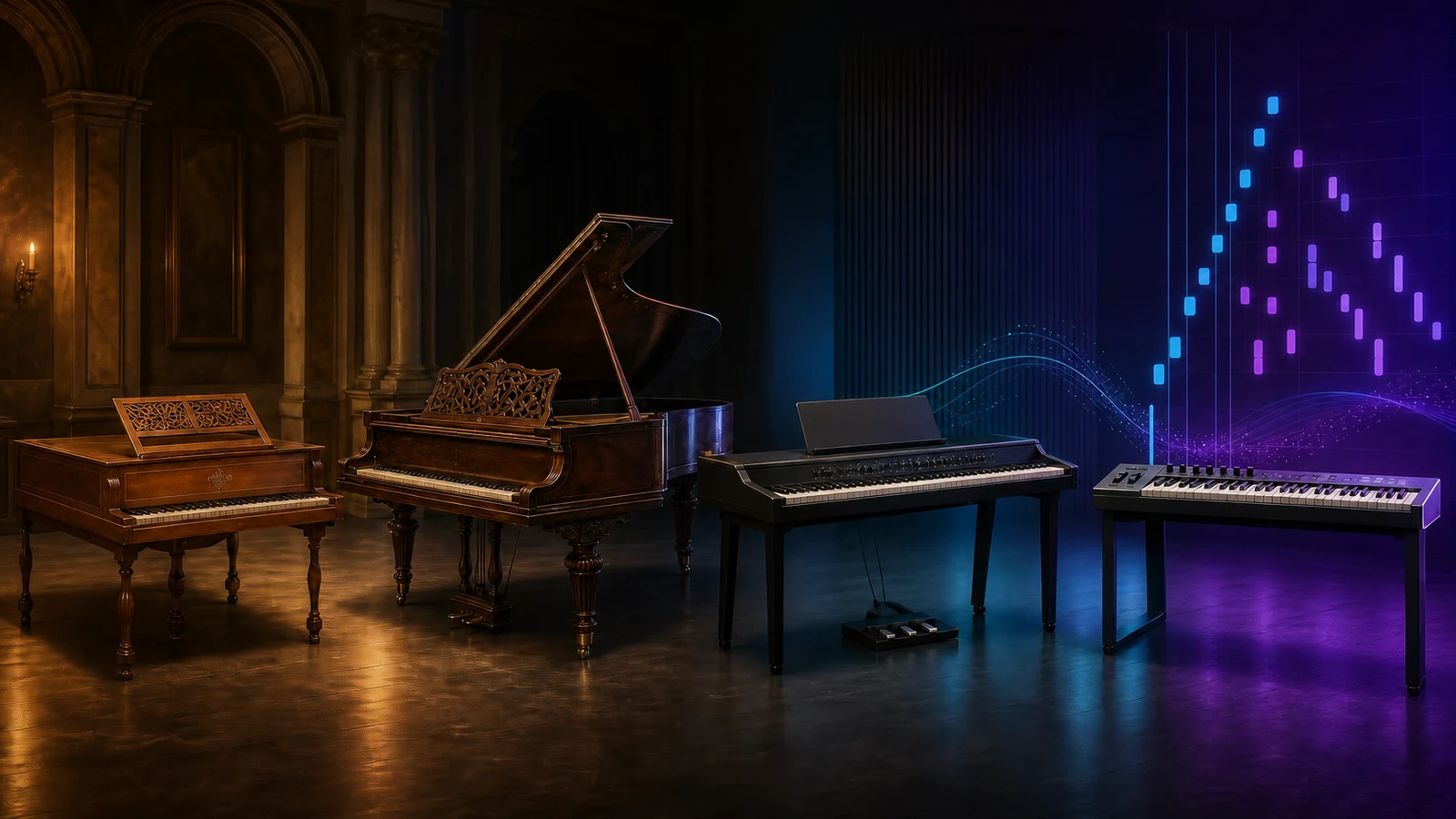
Turn a static score into editable MIDI
Contents
The history of the piano is not simply a parade of old instruments. It is the story of one durable musical idea—keys controlling hammers—being rebuilt for new rooms, louder audiences, wider ranges, and eventually digital studios.
Bartolomeo Cristofori's early piano gave players something the harpsichord could not: direct control over loud and soft through touch. Later builders made the instrument stronger and louder. Uprights brought it into homes and schools. Electronic and digital keyboards separated the keyboard from acoustic strings, while MIDI turned a performance into editable musical data.
Here is the useful distinction: the piano did not evolve along one straight line. Its mechanism, shape, social role, and output changed at different speeds.
The piano began with a new kind of touch
Before the piano, European keyboard players already had organs, clavichords, and harpsichords. Each solved a different problem. The harpsichord could project clearly, but its strings were plucked, so pressing a key harder did not create the same direct dynamic response that pianists now expect. The clavichord offered expressive control, but it was too quiet for a large room.
Around 1700, the Italian instrument maker Bartolomeo Cristofori developed a keyboard action that used hammers to strike strings. The Metropolitan Museum of Art's account of Cristofori's pianofortes explains why the action mattered: the hammer had to strike, escape from the string, avoid bouncing back, and allow the damper to stop the sound when the key was released.
That mechanical sequence turned touch into dynamics. A player could shape one note differently from the next instead of merely choosing when a plucked note began.
Cristofori's instrument was first described as a gravicembalo col piano e forte—a harpsichord capable of soft and loud. The name shortened over time, but the central promise remained: a keyboard that translated physical gesture into a wider expressive range.
Eighteenth-century builders refined the action
Cristofori's design was sophisticated, expensive, and slow to spread. Other builders simplified parts of it, adapted the action to regional tastes, and then rediscovered or improved ideas such as escapement and checking. The early piano was therefore a family of experiments rather than one frozen blueprint.
The oldest surviving Cristofori piano, built in 1720 and held by The Met, has 54 keys rather than the modern 88. Its case resembles a harpsichord, and its lighter construction produces a more intimate sound than a concert grand. That makes sense: it was designed for a different musical environment.
The Yamaha guide to the piano's origins gives a clear mechanical lineage from plucked and struck-string ancestors to Cristofori's hammer action. For a closer look at what still happens inside a modern instrument, see our guide to how a piano makes sound.
Early composers and performers did not receive today's piano overnight. They wrote for the range, touch, sustain, and projection available to them. That is one reason historical keyboard music can feel different on a modern concert grand: the notes may be the same, but the instrument's response and scale are not.
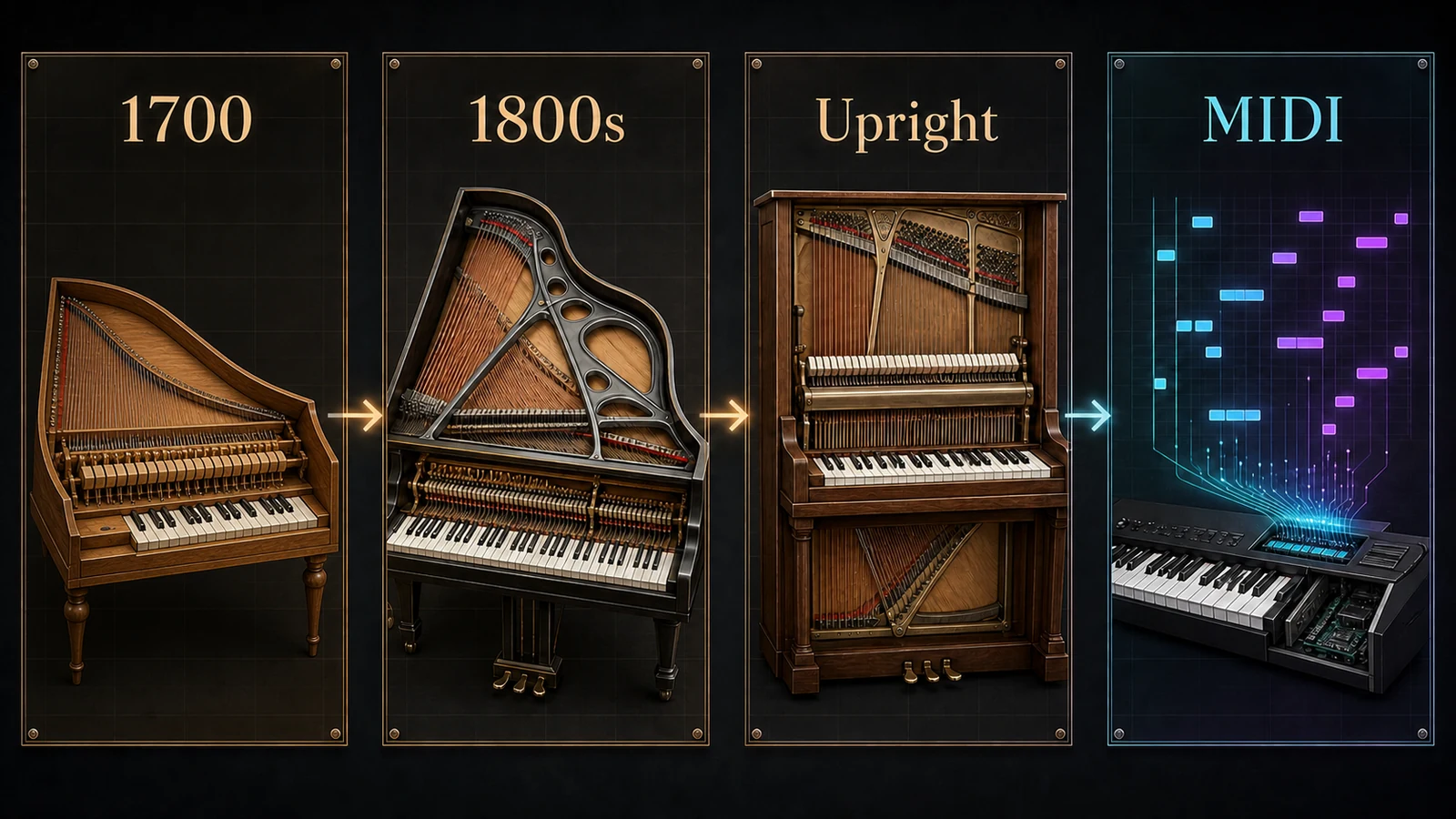
A conceptual construction timeline, not a scale reconstruction of individual museum instruments.
The nineteenth century built the concert piano
As public concerts grew and composers demanded more range, volume, and sustain, piano construction became heavier and more industrial. Builders strengthened frames, raised string tension, expanded the keyboard, and developed actions capable of reliable repetition.
The result was not just a louder piano. It was an instrument suited to a different musical job.
| Change | What it enabled for musicians |
|---|---|
| Stronger framing and higher string tension | More projection and sustain in larger rooms |
| Expanded keyboard range | Wider bass, brighter treble, and more orchestral writing |
| More robust action | Faster repetition and greater dynamic control |
| Larger grand-piano case | Longer strings and a broad resonating soundboard |
| Upright string layout | A practical piano footprint for homes, schools, and studios |
Yamaha's overview of the modern piano's evolution traces the expansion from Cristofori's smaller range toward the 88-key standard and connects stronger construction with the rise of larger concert spaces.
This period also changed composition. The piano could suggest several musical layers at once: melody, inner voices, bass, rhythm, and sustained harmony. It became a solo instrument, an ensemble partner, a rehearsal tool, and a way for one musician to study music written on an orchestral scale.
The modern grand is the most visible result of that pressure. The upright was equally consequential because it made a real piano practical where a grand would not fit.
Uprights changed who could live with a piano
An upright turns the strings and soundboard vertically. That does not make it a small grand folded upward; its action, soundboard behavior, bass-string length, and cabinet all create different compromises. What it changes most obviously is space.
That smaller footprint helped the piano move beyond court and concert settings. It became central to private lessons, school music rooms, rehearsal spaces, churches, silent-film accompaniment, songwriting, and domestic music-making. For many learners, the history of the piano is really the history of the upright they encountered at home or in a classroom.
The spread of uprights also changed the piano's cultural role. A concert grand could represent public virtuosity. A home piano could support daily practice, family entertainment, teaching, hymn playing, arranging, or composing.
If you are comparing the wider keyboard family rather than historical periods, our guide to instruments like a piano separates acoustic pianos, organs, electric pianos, synthesizers, and controllers by touch and musical job.
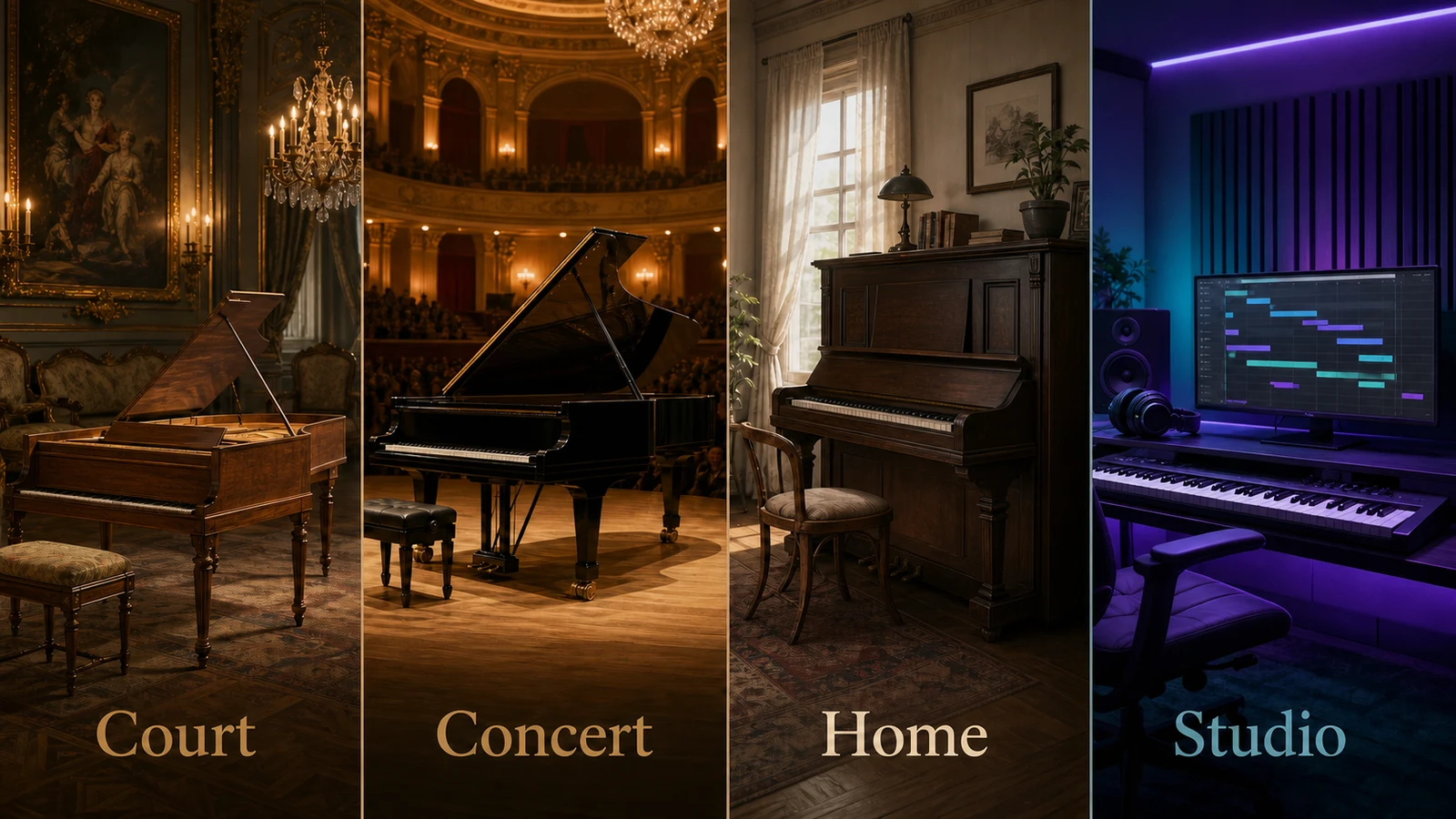
Electricity separated keys from acoustic strings
The acoustic piano creates sound through a physical chain: key, action, hammer, string, bridge, and soundboard. Twentieth-century electric and electronic instruments loosened that chain.
An electric piano still begins with a physical vibrating element, then uses pickups and amplification. A digital piano uses electronic sound generation—often designed to reproduce the experience of an acoustic piano—paired with a keyboard action. A synthesizer may use piano-shaped keys while generating an entirely different sound. A MIDI controller may make no sound on its own at all.
These categories are easy to blur because they can share the same black-and-white layout. Their musical outputs are different:
| Keyboard type | Primary output | What the player controls |
|---|---|---|
| Acoustic piano | Vibrating strings and soundboard | Hammer energy, timing, pedals, resonance |
| Electric piano | Amplified physical vibration | Touch, tone circuit, amp and effects |
| Digital piano | Generated or sampled audio | Touch response, sound engine, pedals |
| MIDI controller | Performance messages | Notes, velocity, timing, controls, connected software |
The keyboard survived because it remained an efficient map of pitch and musical gesture. The sound source no longer had to remain inside a wooden case.
MIDI turned piano playing into editable data
MIDI is the point where the piano's history intersects directly with modern production. The MIDI Association's history of the 1981–1983 standard documents how manufacturers agreed on a common way for electronic instruments to exchange musical messages.
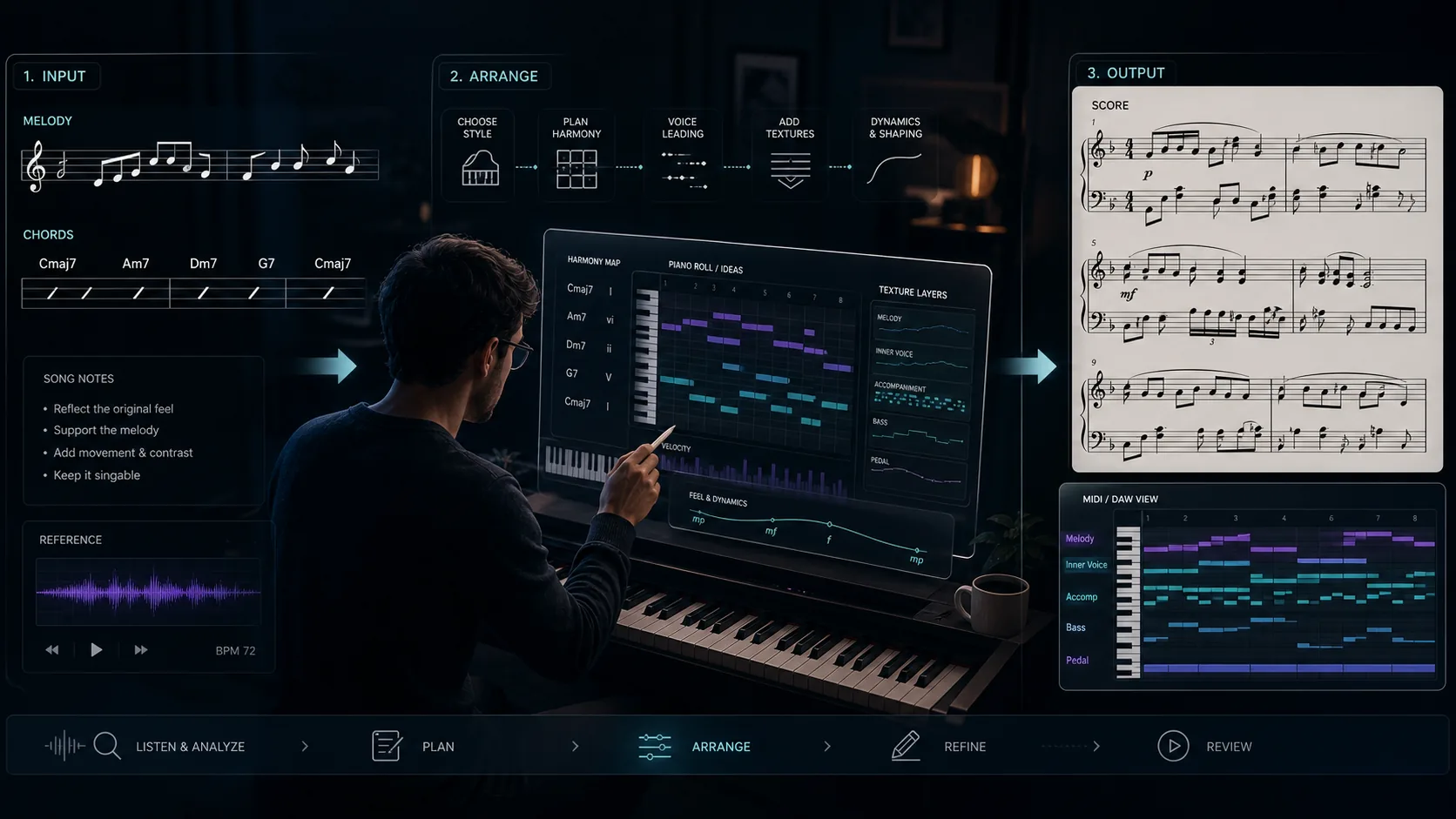
MIDI does not record the acoustic sound of a piano. It records events such as note-on, note-off, timing, velocity, and controller changes. That difference gives modern musicians a workflow Cristofori could never have imagined:
- Perform on a weighted keyboard.
- Record the performance as MIDI in a DAW.
- Move, lengthen, or delete notes without rerecording audio.
- Change the piano sound while preserving the performance data.
- Export the result to notation, another instrument, or a different production session.
This is not automatically better than an acoustic recording. It is better for a specific job: editing the performance as structured note data.
The reverse path is useful too. If you have a clean piano recording rather than MIDI, Melogen's audio to MIDI converter can create a standard MIDI first pass for editing in a DAW or notation program. Clear, isolated piano audio is a better source than a dense full mix, and manual note or timing cleanup may still be needed.
Move a piano recording into MIDI
Use Melogen Audio to MIDI for a first-pass transcription, then inspect notes, timing, and voicing in your DAW or notation editor.
What changed and what stayed the same
Across three centuries, the piano changed in four major ways:
- Mechanism: early hammer actions became stronger, faster, and more repeatable.
- Construction: ranges expanded, frames strengthened, and grands and uprights served different spaces.
- Role: the piano moved among court, concert hall, school, home, stage, and studio.
- Output: performance could become acoustic sound, amplified sound, generated audio, or MIDI data.
What stayed the same is the player's basic relationship to the keyboard. Notes are laid out spatially. Two hands can coordinate independent layers. Touch and timing carry musical meaning.
That continuity explains why a musician can sit at a fortepiano, an upright, a concert grand, or a weighted MIDI controller and still recognize the underlying instrument—even though the sound, resistance, range, and editing possibilities may be radically different.
The practical takeaway
The piano's history is a sequence of changed constraints. Cristofori solved dynamic control. Nineteenth-century builders solved projection, range, and durability. Uprights solved space. Electric and digital instruments changed how sound was produced. MIDI changed what could happen after a note was played.
For a modern musician, the right piano depends on the task:
- Choose an acoustic instrument when physical resonance and room interaction are central.
- Choose a digital piano when quiet practice, portability, or repeatable sound matters.
- Choose a MIDI controller when editing, orchestration, or software instruments are the real destination.
- If your source is printed notation rather than a performance, follow the separate workflow for converting piano sheet music to MIDI.
The piano did not become obsolete as each new version arrived. It became a broader set of instruments and workflows built around the same remarkably persistent interface.
About the author
Zhang Guo
Composer - AI Product Manager
AI product manager and digital marketing consultant with a background in music. Creativity is the bridge between rhythm and logic, where musical intuition and mathematical precision can coexist in every meaningful product decision.
Follow on X